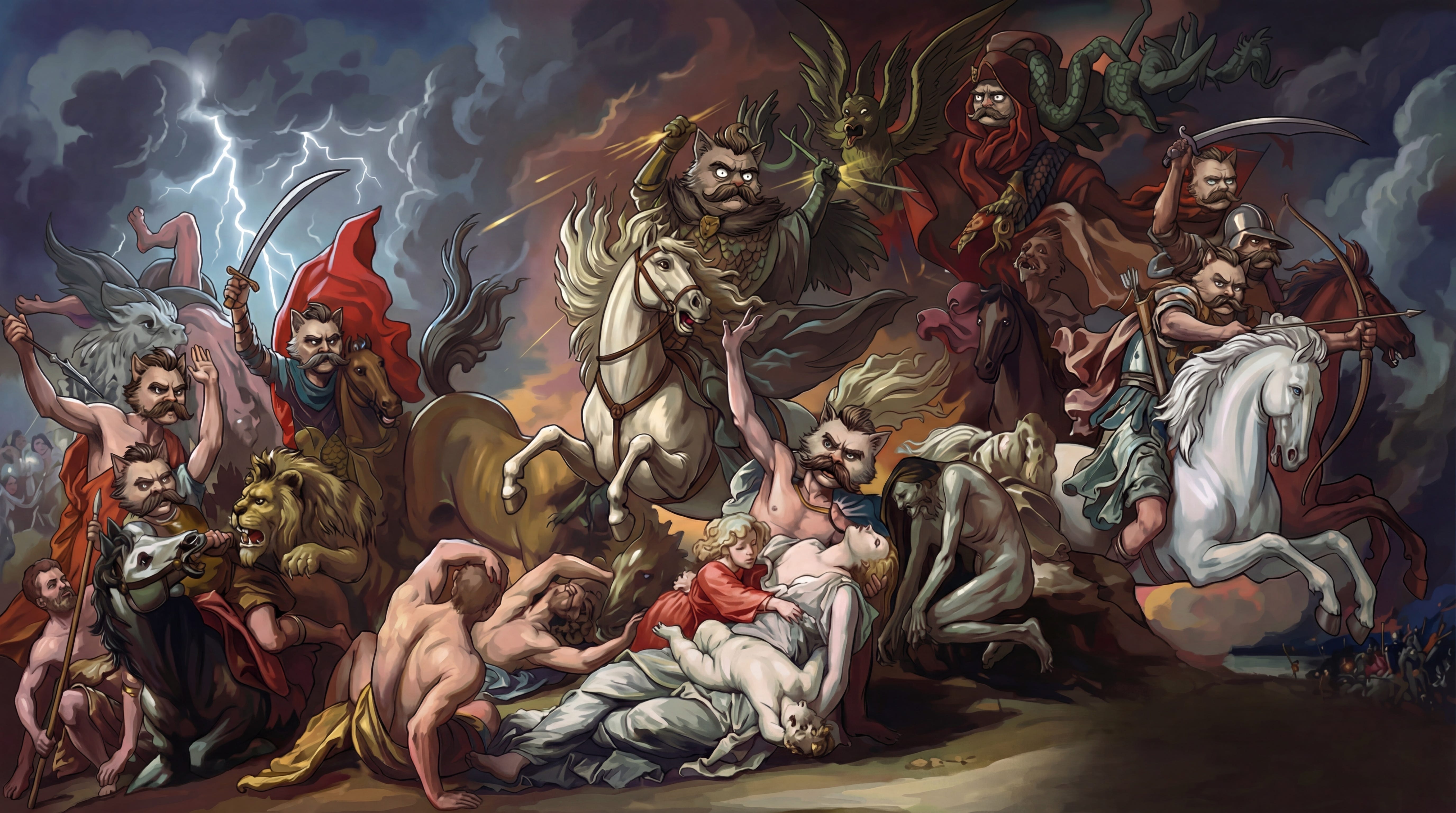
*the following was sparked by a sermon given on 11/9.2025 from “The Well Buffalo”. Give it a listen here.
Let’s be real for a second. If you grew up in evangelical circles like I did, you know the feeling. The music swells, the pastor’s voice drops an octave, and suddenly you’re told that this, right now, today, is the end. The signs are everywhere. Jesus is coming back any minute.
I remember sitting in church around the year 2000, absolutely convinced the clock was running out. It’s a powerful drug, that urgency. It makes you feel important, like you’re part of the “chosen generation” that finally crosses the finish line. It gives your life immediate, cosmic stakes.
But what happens when the clock keeps ticking? What happens when you step back, turn down the emotional music, and actually look at the receipts?
I recently listened to another sermon from The Well Buffalo. Like the last one I critiqued, it was heavy on end-times anxiety and light on historical accuracy. The message was clear: get ready, because the time is short. But to make that point, the sermon had to rely on “facts” that simply aren’t true and a version of history that scholars debunked decades ago.
So, let’s grab a coffee and look at what was preached versus what actually happened. Because if we’re going to talk about the “End Times,” we should probably get the timeline right.
The “Fake History” Used to Scare You
The sermon built a narrative of a young, uneducated church in Thessalonica facing state-sponsored torture to heighten the emotional stakes. It sounds heroic. It’s also wrong.
Here are the specific claims I heard, and the corrections mainstream scholarship actually provides.
1. The “Three Weeks” Myth
The Claim: Paul was only in Thessalonica for three weeks, leaving the church “uneducated” and vulnerable. The Reality: This relies on a hyper-literal reading of Acts 17 (”three Sabbaths”). But if you read Paul’s own letters, the story changes. In Philippians 4:16, he mentions receiving financial support “again and again” while in Thessalonica. In 1 Thessalonians 2:9, he talks about working “night and day” to support himself. You don’t set up a trade and receive multiple aid packages in 21 days. He was there for months, building a community. The “three weeks” line is just dramatic filler to make the church seem helpless.
2. The Nero Fantasy (Anachronism Alert)
The Claim: The sermon likened the Thessalonians’ suffering to Nero using Christians as human torches. The Reality: 1 Thessalonians was written around 50 CE. Nero didn’t start persecuting Christians in Rome until 64 CE, over a decade later. That’s like blaming the 2008 financial crash on COVID-19. It’s an impossible timeline used to artificially spike the emotional temperature of the sermon.
3. The “Identity Theft” Irony
The Claim: Paul wrote 2 Thessalonians because someone forged a letter claiming the Day of the Lord had already come. The Reality: The pastor accepts the “fake letter” theory to validate the text. The irony? A massive chunk of critical scholars believe 2 Thessalonians itself is the forgery. It is widely considered “pseudepigraphical”, written by a later author effectively pretending to be Paul to “fix” the theology of the first letter.
The Hard Truth: They Thought It Was Over Then
Here is the pill that is hardest to swallow, and the one most churches won’t give you without a spoonful of sugar: Jesus and Paul expected the world to end in their lifetime.
This isn’t a fringe theory; it’s the consensus of mainstream scholarship (shout out to Albert Schweitzer).
Jesus said it: “Truly I tell you, this generation will not pass away until all these things have taken place” (Mark 13:30).
Paul believed it: “We who are alive, who are left until the coming of the Lord...” (1 Thess 4:15). Note the “we.” He expected to be there.
When it didn’t happen, the early church had to recalibrate. They faced the “delay of the parousia”. They shifted from “Jesus is coming tomorrow” to “building the church for the long haul.” They spiritualized the kingdom because the physical one didn’t arrive.
Why This Matters (And Why I’m “Calling It Out”)
Why am I picking this apart? Is it just to be a jerk? No.
It’s because bad history leads to bad anxiety. When leaders manufacture urgency by twisting facts, claiming theological “growth” where there is none, or inventing persecution narratives, they keep you in a state of fight-or-flight. They keep you dependent on their interpretation to navigate a scary world.
We have been “waiting” for 2,000 years. From the Millerites sitting on roofs in 1844 to the Y2K panic I lived through, every generation thinks they are the special ones. Every generation thinks they are the ones who will see the sky crack open.
And every single one of them has been wrong.
Maybe it’s time we stopped looking for secret codes in ancient letters and started dealing with the world right in front of us. The honest approach isn’t to pretend the Bible predicts our specific moment, it’s to admit that the authors were human, they were working with limited information, and they were, quite frankly, wrong about the timeline.
And that’s okay. We can handle the truth. We don’t need the fearmongering.
What’s your experience? Did you live through a “Jesus is coming back on this specific date” panic? Let me know in the comments.
← Back to the blog