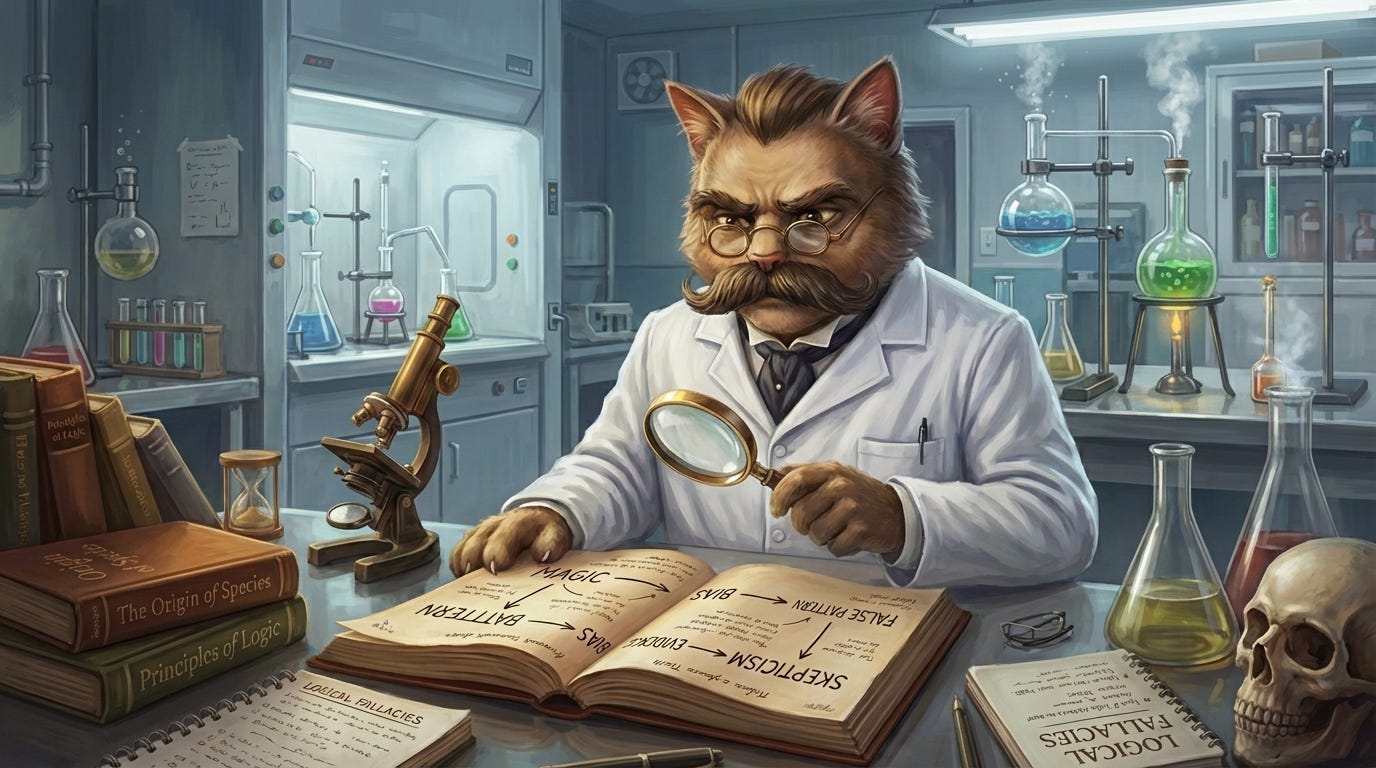
The Comfort of Magic vs. The Grind of Truth: Why Your Intuition is a Liar
Let’s be brutally honest: the human brain was not designed for truth. It was designed for survival.
If you are walking on the savannah and you hear a rustle in the grass, your brain has two choices, and the stakes are life or death:
Type I Error (False Positive): You assume it’s a tiger and run. If it was just the wind, you lose a few calories and look foolish. Result: You survive.
Type II Error (False Negative): You assume it’s the wind. If it’s actually a tiger, you are eaten. Result: You die.
Evolution selected for the paranoid, pattern-seeking ape who sees tigers in the wind, faces in the clouds, and ghosts in the shadows. This is known in evolutionary biology as the Hyperactive Agency Detection Device (HADD). We are biologically hardwired to attribute intention and agency to inanimate events.
This is why you think the universe is sending you “signs.” It isn’t. You are just a biological machine running legacy software that prioritizes safety over accuracy. We are hardwired for “magical thinking”, the path of least cognitive resistance.
Science is not “natural.”
Science is the artificial, difficult, metabolically expensive discipline we invented to override our factory settings. It is the implementation of Daniel Kahneman’s “System 2” thinking. It’s slow, deliberative, and logical compared to the impulsive “System 1.” When people reject science for pseudoscience, they aren’t just being “stupid”, they are surrendering to their evolutionary programming because it feels safer than the cold indifference of reality.
1. The Myth of “Gatekeeping” (It’s Actually Quality Control)
A popular refrain in online spiritual, wellness, and conspiracy circles is that “academia is gatekeeping.” The claim is that mainstream scientists are protecting their turf and shutting down “revolutionary” ideas (like crystals, energy healing, or flat earth) because they are afraid of the truth.
This is a fundamental misunderstanding of the Hierarchy of Evidence.
In the world of science, all opinions are not created equal. Democracy works in politics, but it does not work in physics. We do not vote on the speed of light.
The Tiers of Truth:
The Bottom (Trash Tier): Anecdotes, YouTube videos, and “it feels true to me.”
Why it fails: Humans are subject to the Placebo Effect, Confirmation Bias, and Regression to the Mean. If you have a cold, take a homeopathic sugar pill, and get better three days later, the pill didn’t cure you. Your immune system did. The anecdote “it worked for me” is statistically meaningless.
The Middle: Observational studies and cohorts.
These show correlation, not causation. They are useful hints, but not proof.
The Top (Gold Standard): Randomized Controlled Trials (RCTs) and Meta-Analyses.
This is where we blind the participants and the researchers to eliminate bias. If your “magic” disappears when you can’t see what you’re doing, it wasn’t magic. It was bias.
“Gatekeeping” is the mechanism of Peer Review. It is an adversarial process. When a scientist publishes a paper, they are entering a gladiator arena where their colleagues, who are often their competitors, try to tear the data apart to find errors in methodology or calculation.
If you claim you can heal cancer with your mind, you are not entitled to respect, you are entitled to scrutiny. If your idea cannot survive the arena, it doesn’t belong in the canon of human knowledge. That isn’t oppression, that is epistemic hygiene.
2. Skepticism is Not Cynicism (The Muscle vs. The Couch)
We must distinguish between two behaviors that look similar from the outside but are diametrically opposed:
Cynicism: A lazy dismissal of everything. “It’s all a lie, it’s all a conspiracy, so I won’t bother learning.” This is intellectual cowardice. It protects the ego from having to do work.
Skepticism: A disciplined suspension of belief. “I will provisionally accept this if and only if the evidence warrants it.”
True skepticism relies on the principle of Falsifiability, proposed by philosopher Karl Popper. To hold a scientific belief, you must know what strict conditions would cause you to abandon that belief.
The Litmus Test
Ask a believer in astrology, ghosts, or crystal healing:
“What specific, physical evidence would convince you that you are wrong?”
If they say, “Nothing could convince me, I just know,” they are not engaging in inquiry. They are engaging in theology. They have immunized their claim against reality.
Skepticism is the grind. It is the refusal to accept the comfortable answer just because it feels good. It forces us to ask: Is this true, or do I just want it to be true?
3. The Neuroscience of “Magic”: Why You See Ghosts
Let’s look at the “Ghost” argument through the lens of hard neuroscience, specifically the work of Dr. V.S. Ramachandran and Michael Persinger.
You might say, “But I saw a ghost! I felt a presence! You can’t tell me my experience wasn’t real.”
Here we must make the most important distinction in critical thinking:
Phenomenology: What the experience felt like to you (internal).
Ontology: What actually exists in the physical world (external).
I am not denying your Phenomenology, I am sure you felt fear and saw a shape. I am denying your Ontology, that a dead soul was in the room.
The Brain is a Reality-Generator, Not a Camera
We know, thanks to Ramachandran’s work on Phantom Limbs, that the brain is a reality-generating machine. If you lose an arm, your brain, desperate for input from the severed nerves, will cross-wire sensory maps. It will create a vivid, painful, “real” arm that isn’t there.
If the brain can hallucinate an entire physical limb that obeys your mental commands, do you really think it can’t hallucinate a dead relative in a dimly lit room?
The “God Helmet” and The Temporal Lobes
Furthermore, we have located the hardware responsible for these “spiritual” sensations. Stimulating the Temporal Lobes (specifically the amygdala and hippocampus) can artificially induce the “sense of a presence,” out-of-body experiences, or profound religious ecstasy.
Dr. Michael Persinger developed the “God Helmet,” a device that uses weak magnetic fields to stimulate these lobes. He could make perfectly rational atheists feel like there was a “presence” in the room just by flipping a switch.
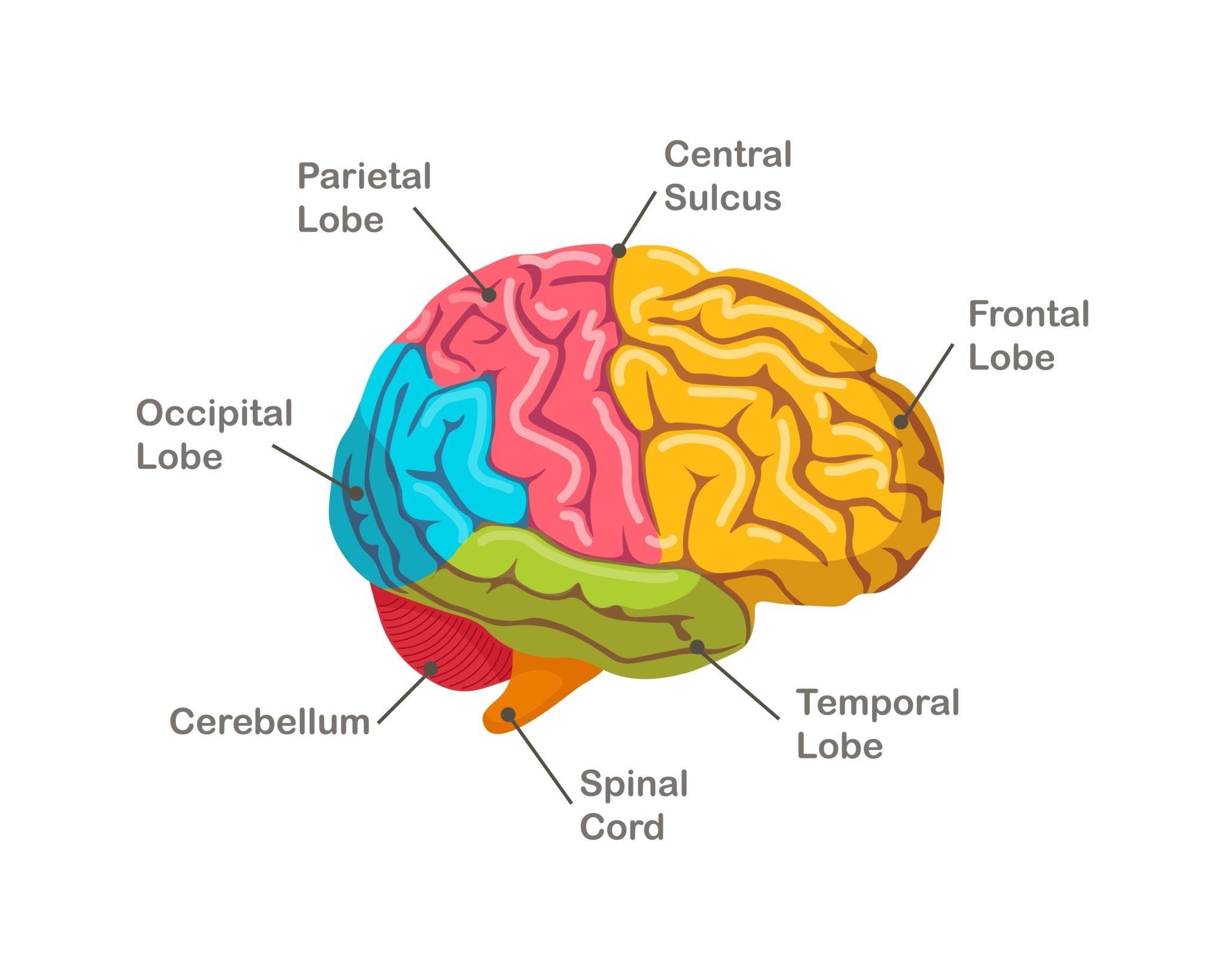
This proves that the “sense of spirit” is a neurological event, not a metaphysical one. It is biology, not theology.
Apply Occam’s Razor (The Principle of Parsimony)
When you experience something weird, you have two explanations:
Explanation A (The Magic): An invisible, immaterial entity from a dimension we cannot detect has defied the laws of thermodynamics, gravity, and electromagnetism to rattle your window, yet refuses to show itself when a camera is recording.
Explanation B (The Brain): You were in a hypnagogic state, your temporal lobe misfired, and your pattern-recognition software created a false positive (a “tiger in the grass”) to keep you alert.
Science demands we exhaust Explanation B before we even glance at Explanation A. To choose the ghost is to bet against the house when the house has never lost.
4. The Abuse of “Energy” and Quantum Woo
One of the most egregious crimes against intelligence is the misappropriation of the word “Energy.”
In physics, energy is a measurable quantity: the capacity to do work. It is measured in Joules. It comes in specific forms: kinetic, thermal, chemical, electrical.
In the “wellness” world, “energy” is used as a vague synonym for “magic.” People talk about “bad energy,” “high vibrations,” and “frequencies.”
Fact Check: If you claim to be manipulating “energy,” take out a voltmeter or a calorimeter and measure it. If you can’t measure it, you are using a metaphor, not a force of nature.
This often bleeds into “Quantum Woo”, the misuse of quantum mechanics to justify spiritual claims. Gurus love to say, “Quantum physics proves that consciousness creates reality!”
No, it doesn’t.
Quantum mechanics deals with the probabilistic behavior of subatomic particles. It does not apply to macro-objects like human brains or “manifesting” a parking spot. Using the Double Slit Experiment to explain why you texted your ex is not science; it is a category error.
5. Logical Fallacies: The Toolkit of Deception
To navigate the world of pseudoscience, you must learn to spot the logical traps used to bypass your critical thinking.
The Appeal to Nature Fallacy
“It’s natural, so it must be good for you. Chemicals are bad.”
Cyanide is natural. Arsenic is natural. Hurricanes are natural. Being eaten by a bear is natural. Meanwhile, antibiotics, eyeglasses, and HVAC systems are “unnatural.” Nature is not benevolent, nature is indifferent and frequently tries to kill you.
The God of the Gaps
This is the tactic of retreating into ignorance.
“Science can’t explain X, therefore it must be Magic.”
Throughout history, we used magic to explain lightning, disease, and the tides. Then we discovered electricity, bacteria, and gravity. The “Magic” explanation has a 100% failure rate over a long enough timeline. Just because science hasn’t explained something yet doesn’t mean your specific supernatural theory is the default winner.
Conclusion: Reality is Not a Democracy
If you want to live in reality, you have to do the work. You have to learn logic, you have to understand the scientific process, and you have to be willing to be uncomfortable.
“Magic” is the explanation of last resort. It is a shrinking pocket of ignorance that retreats every time we turn on the light of inquiry. Before invoking the supernatural, we are obligated to exhaust every natural explanation. This is not close-mindedness, it is intellectual honesty. Yet people routinely skip this step. Why? Because natural explanations require work. They demand that you learn biology, psychology, and physics. They force you to confront uncomfortable truths: that your memory is unreliable, that your senses deceive you, and that your brain is a flawed instrument prone to glitches.
Supernatural explanations, by contrast, are emotionally immediate. They offer meaning, agency, and comfort. “A ghost visited me” is far more satisfying than “I experienced a hypnagogic hallucination caused by sleep paralysis and temporal lobe activation.” One makes you special, the other makes you a machine. But comfort is not evidence. The universe does not care about your emotional needs, and reality is under no obligation to make sense in a way that flatters your ego.
The world is complicated. Your brain is fallible. Your intuition is often a liar designed to keep you alive, not to keep you informed. The only way out is through the grind of skepticism, evidence, and relentless self-correction.
Comfort is easy. Truth is hard. But if we keep choosing comfort, we’ll stay exactly where we are: naked apes on the savannah, telling ourselves stories about the wind.
← Back to the blog