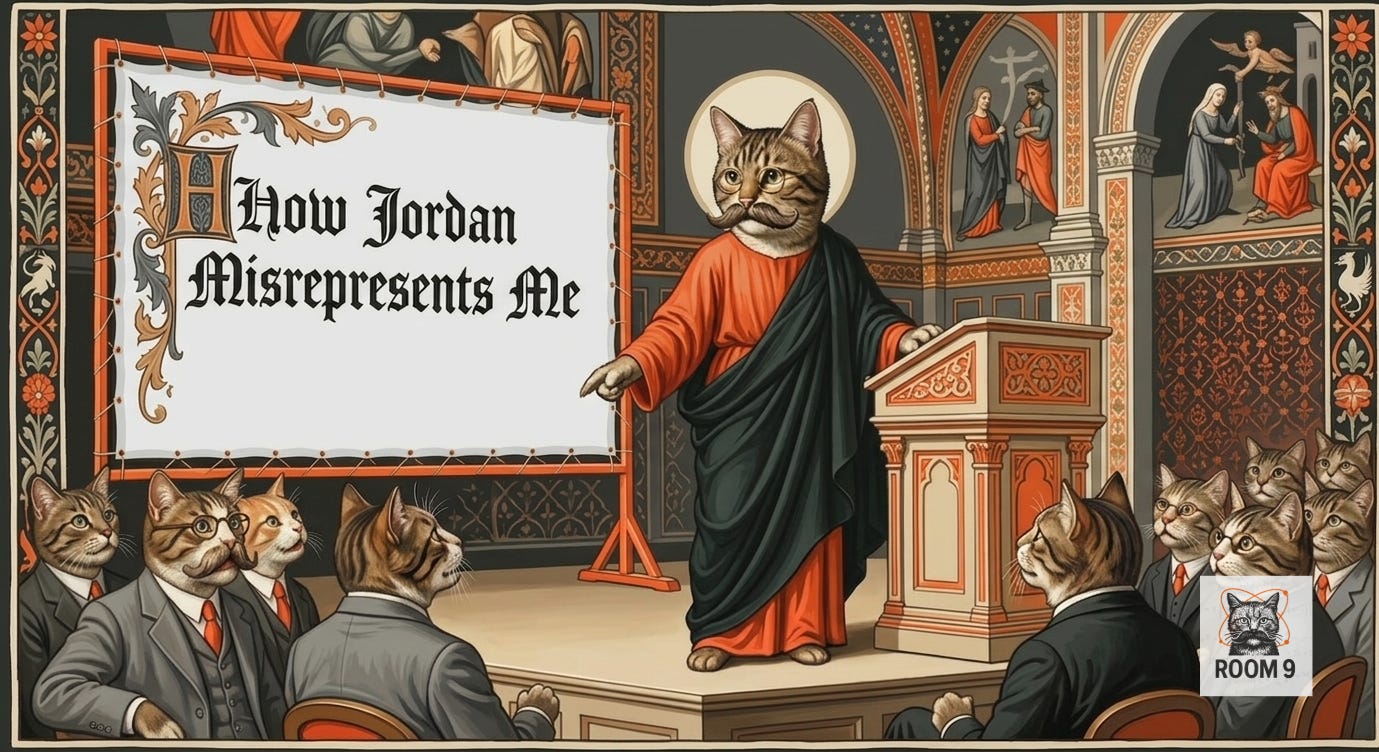
I’ve been reading Nietzsche seriously for roughly 4 years now, and if you stick with him long enough there is a point where the “chaos” stops looking like chaos. After about a one year hiatus I decided to revisit some of his work.
This dive got sparked after coming across a recent video Jordan Peterson released from his “school” Peterson Academy.
In Full Transparency: I use to be a Peterson fan. I remember the day I stumbled across his series of lectures on personality. The scene in is class was basic. A still shot of this professor who was using an overhead-projector with his LAV Mic which the mic + wire was completely outside his shirt. This Dr. Peterson had humility and curiosity in his tone and speech. Then he decided to join The Daily Wire… 💁💁💁
Peterson likes to name drop Nietzsche constantly. And eventually, like any other skeptic, I decided to start reading Nietzsche myself to see if he was full of shit or not.
I go into it in greater detail below, but it becomes obvious that Peterson is either dishonest or stupid.
I have personally had Peterson lovers tell me that his views on Nietzsche are correct even tho they know dam well that they have never read an effin sentence from one of his books. When you take the time to do so instead, instead worshipping a person and taking them at their word, you come to the realization how often Peterson flattens him into a moral therapist all while attempting to smuggle Christian metaphysics back in through the side door.
This was all brought back up to the service after Peterson recently released a video from his Peterson Academy on Nietzsche.
Don’t worry…watching that video didn’t convert me back into a Peterson fan boy. In fact, it once again reminded me why going to the primary text matters, and why Nietzsche is so easily domesticated by people who need him to mean something safer than what he actually says.
When you first open one of his books, and you are a dumbass like myself, Nietzsche reads like a hostile wilderness of aphorisms, paradoxes, polemics, deliberate self-contradictions, and an attitude that feels like it was designed to repel anyone who wants an easy takeaway. It takes time, patience, and many rabbit holes to start being able to make sense of him.
But eventually the fragments stop feeling random. The “contradictions” start looking like a tool he uses to expose the reader’s need for certainty, comfort, and moral safety. Every once in awhile something snaps into focus. And when that happens, Nietzsche stops being a writer you merely “interpret.” He becomes a writer you use. This shift is especially intense if you’ve watched your worldview collapse, not as a clever intellectual exercise, but as an existential demolition.
This shift is especially intense if you’ve watched your worldview collapse, not as a clever intellectual exercise, but as an existential demolition.
When a worldview collapses, it rarely feels like an “intellectual update”. It feels like a free-fall. Nietzsche describes this as the horizon clearing: the old metaphysical boundary is gone, the sea is open, and you’re exposed to the consequences of living without a guaranteed ceiling. But his real warning is about what people do to escape that exposure. They rebuild the same need for certainty under a new banner. You stop believing in God and start worshipping “Truth,” “Science,” politics, morality, or even other supernatural things. The hard discipline is not just surviving this collapse; it’s resisting the reflex to replace one dogma with another and learning to live on the open sea.
Once you’re in that free-fall, you face a serious problem: how do you avoid replacing one dogma with another? Because if you lose one and immediately fall into a paralyzing nihilism or you rebuild your identity around some new ideological certainty, you didn’t escape the machine, you just switched teams.
The transition from a shit worldview to one that has you build values without metaphysical guarantees changes how you read Nietzsche. The Gay Science (especially Book V) stops being a “literary curiosity.” It becomes an existential map.
Now here’s the pivot: Book V isn’t just “more aphorisms.” It’s Nietzsche returning to the text after he’s already crossed into the late-phase project. If you miss that, you miss the whole point.
Book V: The Addition To The Gay Science
The first edition of The Gay Science came out in 1882 and ended with Book IV and the dramatic “Incipit tragoedia,” which basically opens the door for Thus Spoke Zarathustra. Then, in 1887, after Zarathustra and after Beyond Good and Evil, Nietzsche does something very deliberate… he “reboots” the project.
He obtains the rights to his earlier work, writes new prefaces, appends an entirely new fifth book (“We Fearless Ones”), and adds an appendix of songs. That’s not a casual add-on. It’s a bridge. He’s welding the early “free spirit” phase to the mature late-phase doctrines. He’s telling you: you thought you knew what this book was; now watch what it becomes.
Even the title matters. “Gay science” (la gaya scienza) gestures to the Provençal troubadours, an art that’s light-footed, performative, musical, experimental. Nietzsche is not pitching “science” as sterile positivism or academic seriousness. He’s pitching a discipline of knowing that can dance. A pursuit of knowledge that doesn’t need to lie to itself in order to be “respectable.”
Book V shifts the lens. Book IV is still heavily about personal cultivation. How the free spirit learns to breathe after leaving the old moral air. But Book V starts reaching for something bigger. Cultural revaluation, political perfectionism, the preparation of future philosophers as designers of the human horizon.
And it’s rooted in Nietzsche’s physiological naturalism: your philosophy is not a “pure” product of reason. It’s an interpretation of your body. Your values are not floating in Platonic heaven. They’re symptoms of vitality or distress, of richness or deficiency.
Nietzsche draws a brutal line. There’s philosophy written out of sickness (life impoverished, needing escape) and philosophy written out of superabundance (life overflowing, able to affirm even terror). Sickness, he says, can be a liberator of the spirit, it forces suspicion and it makes you interrogate what you once worshipped. It turns the Roman numeral V (five, the “given” shape of things) into an X: an unknown you have to solve rather than assume.
Now let’s walk through the key aphorisms of Book V. Not as museum pieces, but as moves in a coherent strategy.
Systematic Aphoristic Analysis of Book V
Aphorism #343: The News of the New Dawn and the Open Horizon
GS#343: “What our Cheerfulness Signifies,” and it’s basically Nietzsche planting a flag that states this is not the same book anymore.
He defines the “death of God” in the most concrete way possible: the belief in the Christian God has become unbelievable. Not “God is literally dead.” Not some poetic mood. A historical psychological fact that the plausibility of Christian metaphysics is collapsing.
Nietzsche is not naïve about what this means. He predicts a long breakdown. But then comes the part that modern commentators, AKA Jordan Peterson, either ignore or invert: Nietzsche describes an exhilaration among the free spirits. A relief. A cheerfulness. Not because nihilism is fun, but because the ultimate transcendent boundary has been removed.
He uses the “open sea” metaphor: the horizon is cleared. The old land behind us is demolished. Now we can sail. It’s dangerous, but it’s finally possible.
And then he drops a warning that’s more relevant now than ever: the “shadow of God” lingers. Even after you “stop believing,” your values can still be leftover Christianity in secular drag. This matters because it sets the tone for everything. Nietzsche is not celebrating chaos for its own sake. He’s celebrating the removal of the final metaphysical ceiling.
Aphorism #344: The Metaphysical Underpinnings of the Scientific Enterprise
GS#344: “How we, too, are still Pious,” Nietzsche does something that irritates both religious apologists and smug atheistic positivists.
He argues that modern science, which prides itself on abandoning faith, still rests on an unexamined metaphysical premise: an absolute, unconditional “will to truth.” Science says truth at any cost. Truth above all. Truth even if it destroys you.
Nietzsche asks: why? Where did that absolute valuation come from? And why is it treated as self-justifying?
Because biologically, life doesn’t run on truth. Life runs on appearance, perspective, simplification, error, and illusion. That’s not a moral condemnation, it’s a descriptive claim about how organisms survive. If you try to live as a pure truth-machine, you’re basically trying to live as an anti-organism.
So Nietzsche makes the scandalous move. The will to truth is a continuation of Christian and Platonic metaphysics, “God is truth,” “truth is divine.” Even the secular scientist can still be the last idealist, kneeling at a new altar.
His warning is that an unconditional will to truth can conceal a will to death. A hostility toward the conditions of life itself.
If you’re the kind of person who left Christianity and immediately became a dogmatic worshipper of “the facts” without questioning what you’re doing psychologically, Nietzsche is talking to you.
Aphorism #346: The Note of Interrogation and the Rejection of Metaphysical Oppositions
GS#346: “Our Note of Interrogation,” Nietzsche goes after a common failure mode: the reactive atheist who still thinks like a Christian.
The posture is this. Man versus the world. Man as judge. Existence on trial. The world is wrong; man is right. The atheist drops God but keeps the moralized structure. Reality is supposed to obey our standards, and if it doesn’t, it’s “evil” or “absurd.”
Nietzsche calls this monstrous impertinence. It’s still metaphysical pride. It’s still a refusal to integrate humanity back into nature. It’s still dualism.
He’s basically saying: you don’t get to remove God and keep the old courtroom.
Aphorism #347: Conviction as a Measure of Weakness
GS#347: is one of those aphorisms that hits like a slap if you’ve ever watched yourself (or others) cling to certainty like a life raft.
Nietzsche suggests the “need to believe” is inversely related to psychological strength. Weak vitality requires rigid convictions, religious dogma, political ideology, even simplistic “scientism”, because ambiguity feels like death.
The higher type, the freer type, can tolerate slack feelings. They can live inside ambiguity without panicking. They can treat convictions as hypotheses, tools, provisional fictions discardable when they stop serving life.
Here’s why this matters for contemporary culture. A huge amount of modern politics is not about “ideas.” It’s about the emotional need for certainty under conditions of instability.
Nietzsche sees that coming a mile away.
Aphorism #349: The Origin of the Will to Power
GS#349: takes aim at evolutionary stories that make “self-preservation” the fundamental drive.
Nietzsche says: self-preservation is often the consequence of weakness, it’s what you cling to when you’re in distress. The deeper drive is expansion: overcoming resistance, assimilating, dominating, projecting force outward. “Will to power” is not a moral slogan here. It’s a physiological description.
This is where people either romanticize Nietzsche or sanitize him. He’s not saying “be a good little meaning-maker.” He’s saying… life is more brutal than your moral framework allows. And if you can’t face that, you’ll keep inventing metaphysics to protect yourself.
Aphorism #354: The Socio-Linguistic Illusion of Consciousness
GS#354: is shockingly modern. Nietzsche argues consciousness is not the core of human identity. Most of thinking, willing, feeling, acting happens without it just like other animals.
He proposes that Consciousness develops under the pressure of communication. Humans are vulnerable herd animals, they need to coordinate. So consciousness becomes a “net of communication,” less an inner essence and more a social interface.
And when you translate your unique experience into words you flatten it. You generalize it. You debase it to what can be shared.
This explains why people can spend their whole lives “self-reflecting” and still not know themselves. The medium forces distortion.
Aphorism #357: Leibniz and the Decentering of the Subject
GA#357: Nietzsche extends the critique by attacking the philosophical obsession with the “subject” as a unified causal agent. The “I” is not a simple center. It’s a grammatical fiction masking a battlefield of drives.
This isn’t a cute academic point. It demolishes a lot of moral psychology, a lot of guilt metaphysics, a lot of naïve “self-mastery” narratives.
Aphorism #364: On Eroticism, Possession, and Power
GS#364: gets into gender dynamics and erotic possession in a way that makes modern readers uneasy (for obvious reasons). Nietzsche interprets love and desire through power: to possess, to be possessed, to assimilate.
Whether you agree or not, the move fits the larger project. Spiritualized ideals are rooted in physiological drives. Moral language is often a perfume sprayed over biology.
Nietzsche is constantly dragging the “higher” down into the body.
Aphorism #370: Dionysian versus Romantic Pessimism
GS#370: is one of the clearest windows into Nietzsche’s evaluative psychology. He distinguishes Romantic pessimism from Dionysian pessimism.
Romantic pessimism comes from impoverishment. It seeks escape, quiet, rest, a savior, and deliverance from the pain of being itself. It’s reactive.
Dionysian pessimism comes from superabundance. It can stare into terror and still affirm life. It doesn’t need redemption, it has strength.
This distinction is a diagnostic tool. Nietzsche is asking, when you create values, when you write philosophy, art, morality, are you doing it because you’re overflowing, or because you’re starving? That question is unforgiving. And it’s aimed at your nervous system, not your intellect.
Aphorism #371: The Metaphor of the Growing Tree
GS#371: Nietzsche basically tells you to get used to being misunderstood.
If you’re growing you won’t stay intelligible to people who want stability and sameness. Just ask my ex-wife. 😂😂😂
He uses the tree metaphor. Growth goes up and out, but also in and down. It grows into darkness, into “evil,” into depth. Misunderstanding isn’t a PR problem. It’s a condition of becoming. This is Nietzsche preparing you for the loneliness of transformation.
Aphorism #373: The Poverty of Mechanistic Reductionism
GS#373: Nietzsche attacks the fantasy that reality is fundamentally mechanical and therefore fundamentally intelligible.
He says a purely mechanical world would be a meaningless world. He uses a music metaphor… you can measure the vibrations, calculate the frequencies, model the patterns and still miss what music is.
If you reduce existence to what can be counted, you’re not doing “rigor.” You’re doing cowardice disguised as rigor. You’re fleeing ambiguity. And Nietzsche has contempt for that flight.
Aphorism #374: Perspectivism and the New Infinite
GS#374: articulates perspectivism: we cannot see around our own corner. It’s intellectual arrogance to decree that our perspective is the perspective.
Without a single “true” interpretation of the world, existence becomes “infinite” again and becomes open to unlimited interpretations. That can trigger horror. Or it can trigger creative freedom. And Nietzsche’s wager is that the free spirit learns to use the infinity rather than drown in it.
Aphorism #381: The Question of Intelligibility and the Cold Bath
GS#381: in this aphorism, Nietzsche defends his style and his difficulty.
A serious writer, he says, wants to be understood, but also not understood by those who don’t share the constitution for the thought. He compares deep philosophical problems to a cold bath. You jump in and out quickly to keep vitality. He’s aiming at a kind of intellectual dance. Flexibility, speed, play.
Which is exactly why your average academic, your average pundit, and your average “content philosopher” tends to misread him. They’re trying to turn the dance into a sermon.
Aphorism #382: The Great Health
GS#382: introduces the “Great Health”: the capacity to integrate suffering, sickness, joy, terror, and strength into a single affirmation of life.
This is not “positive thinking.” This is not “self-help Nietzsche.” This is the psychological prerequisite for revaluating values without needing metaphysical crutches.
It’s the kind of health that can survive the death of God without immediately building a new god out of science, politics, or morality…
That’s the point.
The Misrepresentations of Book V
Now we get to the part that matters for how Nietzsche gets used and abused in today’s day and age.
Nietzsche’s reception is full of systematic misrepresentations that don’t merely “misunderstand” him; they invert him. They take dynamite and turn it into a foundation block.
And one of the most visible examples in contemporary culture is Jordan Peterson.
Peterson is not stupid. But he often reads Nietzsche in a way that domesticates him and it turns him into a moralizing ally in a project Nietzsche would have hated: rescuing Christian metaphysics by translating it into psychological narrative.
Here are some examples.
Misinterpretation 1: The “Death of God” as a Crisis of Despair
Peterson frequently frames the death of God as a catastrophe that produces despair, moral collapse, and political totalitarianism. So Peterson thinks we should cling to Judeo-Christian values to prevent chaos.
If you’re paying attention and are able to take Peterson off the pedestal you have him on, book V does not allow that reading.
Nietzsche explicitly describes a cheerfulness among free spirits in GS 343. He describes an exhilaration that the horizon is open, that the sea is open, that the old boundary is gone. Yes, he predicts traumatic consequences for the masses. But Nietzsche’s own posture is not “return to the corpse.” It’s “now we can finally breathe.”
If your response to the death of God is to cling to Christianity out of fear of chaos, Nietzsche would diagnose you immediately as being psychologically weak. That is the “need to believe” he dismantles in GS 347. That is precisely what the free spirit is supposed to overcome.
Misinterpretation 2: The Sanitization of the Will to Power
Peterson’s framework tends to moralize power: values should be created for flourishing, minimizing suffering, stabilizing meaning.
Nietzsche is not doing that. Not here.
For Nietzsche, “will to power” is not a moral prescription needing justification. It’s a non-moral physiological reality. Life expands. Life overcomes. Life assimilates. Nature terrorizes, dominates, exploits. If you sanitize that into a polite meaning-framework, you are not “clarifying Nietzsche.” You are replacing him.
He is not offering you a therapeutic narrative to make modern liberal morality feel safe. He’s telling you your morality is a symptom, and you should be suspicious of it.
Misinterpretation 3: The Literalization of the Übermensch
People love to literalize the Übermensch as an achievable end-state, a secular savior, an Ayn Rand hero. But Book V’s entire critique of the unified subject undermines that simplistic literalization. Selfhood is emergent. Drives compete. Consciousness is a net. The “I” is not a monarch.
The Übermensch functions less like a “goal you reach” and more like a symbol for continuous self-overcoming and if you turn it into a political mascot or a self-help endpoint, you missed the mark completely.
Misinterpretation 4: Weaponizing Philosophy to Validate a Pre-existing Worldview
Peterson often filters Nietzsche through Jung and then uses the filtered product to support a conservative worldview already in place.
Nietzsche’s project is not to validate your worldview. IT’S TO SMASH IT!
He is an intellectual sledgehammer. If the reading leaves you morally comforted, metaphysically reassured, and culturally stabilized, you probably reading him wrong.
Misinterpretation 5: The Secularized “Religion of Facts”
On the other side, there’s the positivist misreading: Nietzsche killed God, therefore Nietzsche must be pro-science, pro-objectivity, pro-fact-worship.
Again: GS 344 exists.
Nietzsche is warning you not to replace God with “Truth” as a new absolute. The modern secular world is perfectly capable of building a new temple and calling it “objectivity.” That’s the shadow of God all over again. He is not telling you to reject science. He’s telling you to stop worshipping it. The free spirit uses science as a tool without kneeling.
[side note: this is a common apologetic move. You know what I am talking about. When a Christian “mind reader” tells you that you have faith in science, or that you worship science]
Conclusions: The Revaluation of the Intellectual Conscience
Book V of The Gay Science is not a cute rebellion text. It’s not an edgy atheism pamphlet. It’s Nietzsche laying the groundwork for a dangerous psychological discipline. The intellectual conscience.
It’s the project of revaluation that starts in the body, in drives, in physiology, and ending in the question of what kind of culture can exist on the far side of metaphysics.
And if you’ve lived through the collapse of your absolute foundations, whether through tragedy, doubt, or brutal intellectual honesty, Nietzsche gives you a warning that is easy to ignore and fatal to miss:
Don’t replace the old temple with a new church.
Don’t swap Christianity for scientism. Don’t swap theology for political ideology. Don’t swap God for “facts” and pretend you’re free.
Those are all shadows. They’re all ways of refusing the open sea.
The free spirit cultivates the capacity to face the collapse of absolutes without mourning like an orphan, and without rebuilding the same structure under a new name. The horizon is open. The sea is open.
And the question is whether you have the courage to sail.
Special shoutout to one of the most honest Nietzsche writers out there, ! Anyone who wants an objective guide while you study the text yourself you better follow him everywhere.
← Back to the blog