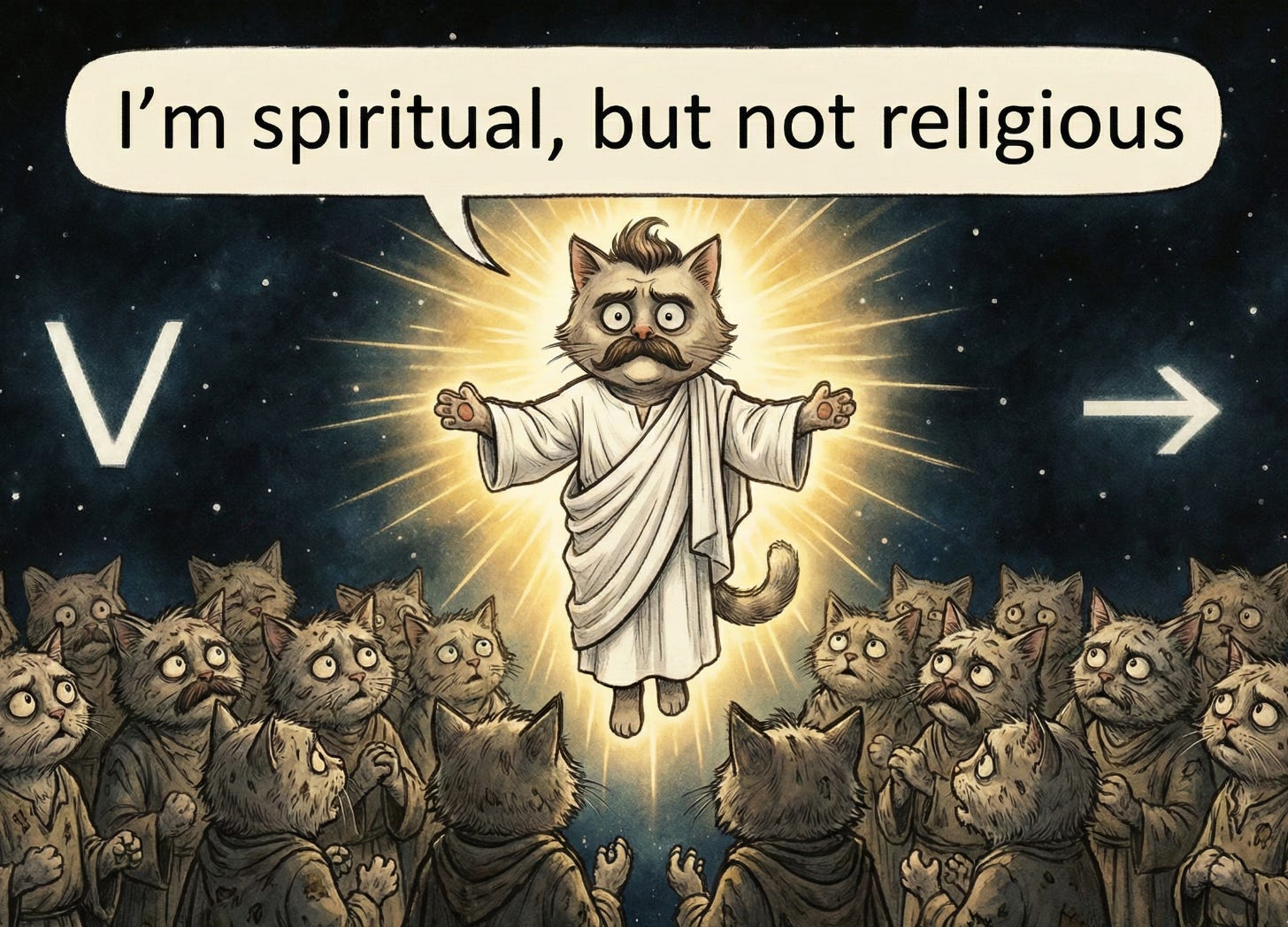
The phrase “I’m not religious, I’m spiritual” has become a cultural badge. It’s how people distance themselves from organized religion while still claiming special insight, special access, special depth.
Scratch beneath the surface and you usually find a mess of intellectual laziness, cherry-picking, and double standards. The worst version hides behind radical skepticism (“you can’t prove anything!”) and then tries to drag science down to the level of faith.
This is about calling that out for what it is: BULLSHIT.
The “spiritual check-in” that wasn’t a check-in
I recently had a gentlemen message me on FaceBook that I knew from back in my recovery days. It started like a lot of recovery messages/texts do: a warm opener, a little brotherhood, and then a long message that wasn’t really about me.
The tone was friendly. The content was not. It was a worldview dump.
In a couple paragraphs, they managed to:
Reframe NA as basically a Vedic tradition.
Call India a uniquely “spiritual country.”
Diagnose “church people” as lacking “soul and spirit.”
Suggest that going to church is mostly about moral superiority.
Float the idea that we can’t really know what God is anyway.
Crown me as a “unifier” with a “gift.”
And then drop the recovery credentialing question: “Have you completed the steps?”
I’m not mad at the encouragement. I’m allergic to the move underneath it.
Because a lot of “spiritual” talk isn’t actually about humility. It’s about authority.
The pattern is familiar: say you’re open-minded, dismiss everyone else as asleep, and then claim special access to what’s really going on.
How “spiritual” becomes a shield
When I pushed back, it didn’t get clearer. It got weirder.
Gossip, they said, is “black magic.” Gurus can do things we would call magic. There was talk of mind control, radio waves, and how Buddhism says everything is an illusion made of light, which was supposedly “proven” by science because “everything is made of light.”
Then the anecdotes came in like receipts:
A guru’s body didn’t decompose for eight months.
A yogi’s autobiography where a guru allegedly controlled a person’s mind to “teach a lesson.”
That’s when I realized what I was actually dealing with.
Not spirituality.
Bad epistemology.
I’ve been on that road
For the record: I’m not critiquing this from the sidelines.
I’ve done the “spiritual but not religious” tour. I’ve moved from Christianity into Eastern philosophy and spiritual practices. I know why it hooks people. It offers:
Depth without accountability.
Meaning without falsifiability.
Community without doctrine.
Wonder without standards.
It can feel like maturity, but usually it’s a slow-motion retreat from reality.
At some point I had to learn a basic rule that cuts through almost all of this:
Meaning is not the same thing as truth.
A story can be moving and still be false. A feeling can be profound and still be misleading. A metaphor can be useful and still be abused.
1. What Does “Spiritual But Not Religious” Actually Mean?
First, let’s be clear: “spiritual” is a folk term. It doesn’t mean any one thing. People use it to gesture at a cluster of subjective experiences; feeling awe, connectedness, or meaning; having “altered states” via meditation, psychedelics, or trauma. Others use it as a label to signal “I’m not nihilistic, but I don’t want the baggage of church.”
Some take it further, claiming belief in “energy,” “the universe sending signs,” life after death, or ghosts….none of which are evidence-based. A tiny minority use it to gesture at actual philosophical positions (dualism, panpsychism), but most just mean “I feel something” and never bother to define it.
The bottom line: “spiritual” is usually about feelings, not arguments or evidence.
2. The “You Can’t Prove Anything!” Crowd and Hard Solipsism
Then there’s the move to radical skepticism: “You can’t prove anything,” “There’s no evidence for anything,” or the hard solipsist’s “Maybe you’re just a brain in a vat.” This is intellectual cowardice masquerading as sophistication.
Philosophical skepticism is a real field, but its practical upshot is not “believe whatever you want.” It’s about rigorously testing claims, not throwing up your hands and declaring all knowledge impossible.
Even the most hardcore philosophers admit that radical skepticism is self-defeating: if you truly can’t know anything, then you can’t know that you can’t know anything.
In real life, we use evidence, logic, and probabilities to navigate the world, otherwise, you’d never get out of bed in the morning.
3. The False Equivalence: “You Have Faith and Belief in Science!”
A favorite move of the “spiritual but not religious” crowd is to claim that science is “just another faith.” This is complete and utter nonsense.
Faith, in a religious sense, is belief without evidence, or even in the face of contrary evidence. Science, on the other hand, is a process: hypotheses are tested, evidence is gathered, and claims must be falsifiable. Scientific theories are constantly challenged and revised; dogma is the enemy.
There is no “faith” in science, just trust in a method that has demonstrated its reliability over and over again. If you had evidence, you wouldn’t need faith.
The only reason religious traditions have changed is because science and secularism forced them to.
4. Double Standards, Cherry-Picking, and Contradictory Reasoning
Here’s where the real hypocrisy comes in: the same people who demand “impossible” standards of proof for scientific claims will accept the flimsiest anecdotal “evidence” for spiritual or supernatural beliefs.
They’ll believe in “energy” or “the universe sending signs” on the basis of a feeling or coincidence, but demand peer-reviewed studies for anything that challenges their worldview.
This is textbook motivated reasoning and confirmation bias, using different standards of evidence for things you want to believe versus things you don’t. It’s cherry-picking at its worst, and it’s intellectually dishonest.
5. The Harm of “Spiritual But Not Religious” Thinking
It’s tempting to see Spiritual But Not Religious (SBNR) as harmless, but this kind of sloppy thinking has real-world consequences.
When people reject evidence-based reasoning in favor of “personal truth,” they become vulnerable to pseudoscience, conspiracy theories, and cult-like thinking. Many who deconstruct from religion simply replace it with new dogmas, crystals, astrology, or whatever New Age trend is in vogue, without ever learning to think critically.
The same logical fallacies and cognitive biases that plague religious thinking are alive and well in the SBNR crowd.
6. Christianity’s Claims of Love, Acceptance, and Forgiveness And the Harm Ignored
Let’s not let organized religion off the hook. Christians love to say their faith is about love, acceptance, and forgiveness. But the historical and scriptural record is full of violence, discrimination, and outright horror.
The Bible contains explicit commands for genocide (Deuteronomy 20:16–17, 1 Samuel 15), rape and sexual slavery (Numbers 31), and the endorsement of slavery (Exodus 21, Leviticus 25, Ephesians 6:5–9). Women are commanded to be silent and submissive, and rape victims are told to marry their rapists (Deuteronomy 22:28–29). There are passages that condone or command the most appalling acts imaginable, all while supposedly being the word of a loving God.
This is not just ancient history. Christianity has been responsible for wars, inquisitions, colonial violence, forced conversions, institutional abuse, and discrimination against women, LGBTQ people, and countless others. And yet, many still cherry-pick the “love” verses and ignore the harm, pretending that the ugly parts don’t exist or don’t matter.
7. The Only Honest Approach: Evidence, Logic, and Accountability
If you care about truth, you don’t get to pick and choose your standards of evidence based on what makes you feel good. You don’t get to hide behind “personal truth” or radical skepticism to avoid hard questions. You don’t get to claim the moral high ground while ignoring the harm caused by your beliefs or institutions.
The intellectually honest path is to demand evidence for all claims, spiritual, religious, or scientific. It’s to admit when you don’t know, to revise your beliefs when the evidence changes, and to hold yourself (and your community) accountable for the harm your ideas cause. Anything less is just horse shit.
“I’m open” is not a blank check
Here’s my actual position, and it’s simpler than people expect.
I’m open to souls, spirits, and the supernatural.
But I’m not going to treat them as default assumptions. If someone is making claims about how reality works, they do not get a free pass because it sounds mystical, Eastern, ancient, or personal.
“Gossip is black magic” might be a poetic way to describe social contagion, reputational harm, and the way narratives spread through a group.
But if you mean it literally, then we are in claim territory.
Same with “mind control,” “radio waves conquering the mind,” and miracle stories. Those are not small add-ons. Those are extraordinary claims.
Extraordinary claims can be true. But they do not get to be true by default.
What counts as a good belief
A good belief is not the one that feels deepest.
A good belief is the one that survives contact with:
Clear definitions.
Independent verification.
Alternative explanations.
Predictive power.
The willingness to change your mind.
If a belief cannot, even in principle, be tested or corrected, it is not knowledge. It is a protected identity.
And if you’re using it to diagnose other people as “soulless,” it’s not just private. It’s harmful.
The Socratic question that ends the conversation or saves it
I replied respectfully, but I refused to play along.
If we’re going to talk about spirituality like adults, we need standards.
So this is what I asked, because it forces the conversation out of vibes and into claims:
What exactly are you claiming is true: metaphor, or literal supernatural power?
What would count as good evidence for it?
What would count as evidence against it?
If the main support is stories and secondhand reports, why should anyone treat that as more reliable than coincidence, misinterpretation, or exaggeration?
What is the simplest explanation that fits the facts without adding supernatural assumptions?
And the final question, the one that doesn’t let anyone hide behind “awakening” language:
What, exactly, do you think you know? And how do you know it?
← Back to the blog