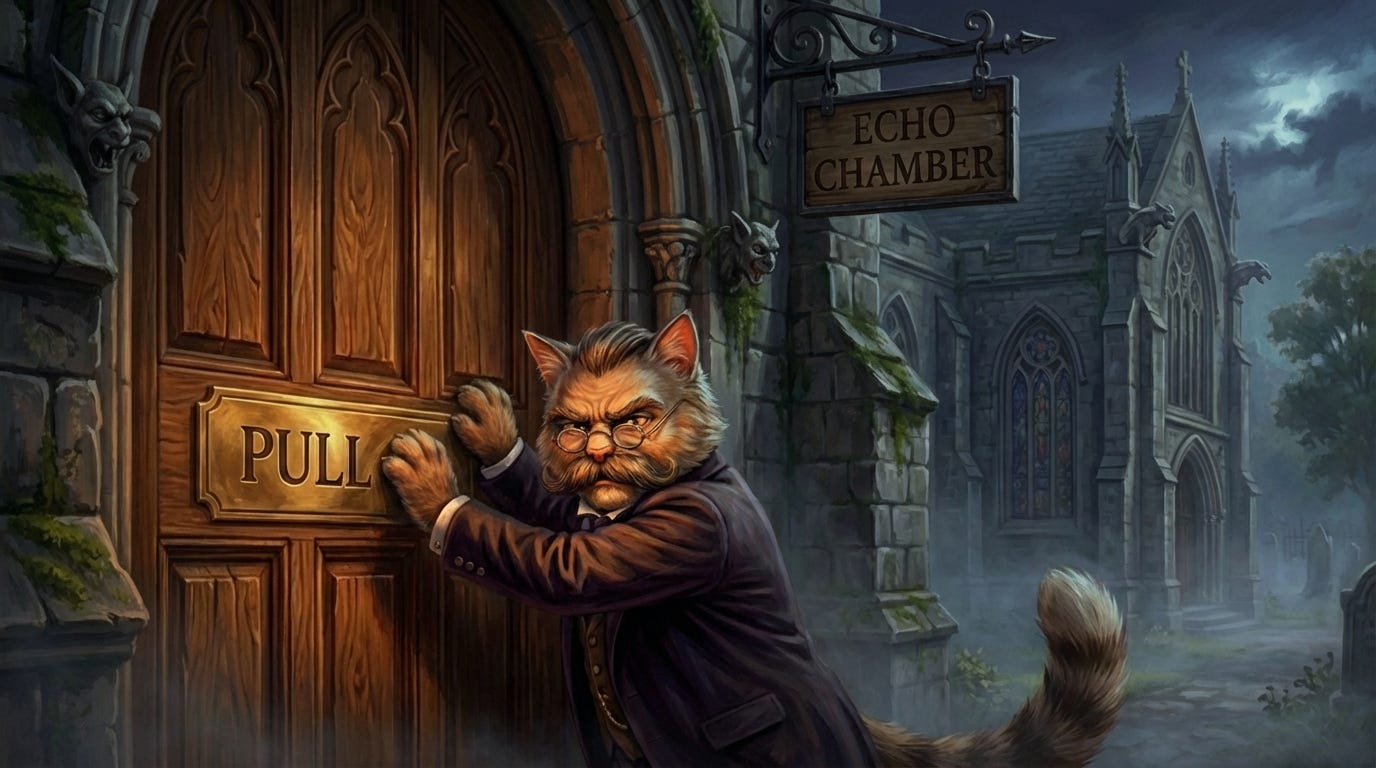
Cognitive dissonance and the Dunning-Kruger effect are two of the most powerful, and most misunderstood psychological forces shaping our beliefs, especially in the domains of religion and politics. I’ve explored both of these concepts in previous posts, but here I want to bring them together to show how they work in tandem to distort our thinking. These are not just academic curiosities; they are the hidden engines behind dogma, polarization, and the stubborn refusal to change our minds in the face of overwhelming evidence. Understanding these forces is essential, but it’s not enough. It is only when we learn how to properly reason, how to test claims, how to spot our own errors; It is only when start with logic can we hope to escape the traps of self-delusion and tribal thinking, and approach something like truth.
This article will take you deep into the mechanics of cognitive dissonance and the Dunning-Kruger effect, show exactly how they manifest in religious and political life, and make the case that logic and critical thinking are not optional nerd skills, they are the only real antidote to the madness of modern discourse.
I. Cognitive Dissonance: The Engine of Self-Deception
What Is Cognitive Dissonance?
Cognitive dissonance is the psychological discomfort we feel when we hold two or more contradictory beliefs, values, or ideas, or when our actions conflict with our beliefs. First described by Leon Festinger in 1957, the theory posits that humans are wired to seek internal consistency. When inconsistency arises, we are motivated, often unconsciously, to resolve the tension, sometimes by changing our beliefs, sometimes by denying or rationalizing away the evidence, and sometimes by attacking the source of the conflict.
Neuroscience has mapped this process to a network of brain regions, especially the posterior medial frontal cortex (pMFC), which monitors for conflict between beliefs and behavior, and the anterior insula, which is responsible for the negative emotional experience of dissonance. The Dorsolateral Prefrontal Cortex (DLPFC) is then recruited to resolve the conflict, often by changing attitudes or rationalizing away the inconsistency.
How Does It Work?
When confronted with evidence that contradicts our beliefs, cognitive dissonance kicks in. The discomfort is so acute that we will go to great lengths to reduce it. This can mean:
Denying the evidence (“That can’t be true”)
Rationalizing the contradiction (“There must be another explanation”)
Attacking the source (“You’re biased/evil/stupid”)
Changing our beliefs (rare, but possible when the evidence is overwhelming and the social cost is low)
Crucially, the more central a belief is to our identity, the stronger the dissonance and the more creative our rationalizations become.
Examples in Everyday Life
Religion: A devout believer is exposed to evidence that their scriptures contain contradictions, or that their religious leaders have committed moral failings. Rather than abandoning their faith, they may reinterpret the evidence, question the credibility of the source, or double down on their beliefs to avoid the pain of dissonance.
Politics: A lifelong supporter of a political party is forced to confront evidence that their chosen candidate has lied or acted corruptly. Rather than switch allegiance, they may dismiss the evidence as “fake news,” blame the other side, or rationalize the behavior as necessary for a greater good.
II. The Dunning-Kruger Effect: The Illusion of Competence
What Is the Dunning-Kruger Effect?
The Dunning-Kruger effect is the well-documented phenomenon where people with low skill or knowledge in a particular area dramatically overestimate their own competence, while those with high skill often underestimate theirs. The original explanation, known as the “dual-burden” account, is that unskilled individuals lack both the competence and the metacognitive tools to realize their own deficits, leading to inflated self-assessments.
Importantly, the effect is domain-specific. It’s not that “stupid people are too stupid to know they’re stupid,” but rather that people who lack skill in a particular area (grammar, logic, political knowledge, etc.) are especially prone to overconfidence in that domain.
How Does It Work?
The Dunning-Kruger effect is partly a result of statistical regression (everyone’s self-ratings tend to regress toward the mean), but genuine metacognitive deficits also play a major role. People at the bottom of the competence curve don’t just lack skill, they lack the ability to recognize what skill looks like, or to spot errors in their own thinking.
This leads to a dangerous combination: ignorance plus unwarranted confidence. When these individuals are challenged, they are not only wrong, but supremely confident in their wrongness, and often hostile to correction.
Manifestations in Real Life
Religion: Fundamentalists with little training in theology or biblical scholarship confidently assert their interpretations as absolute truth, dismissing centuries of nuanced debate. They may attack anyone who disagrees as heretical or “deceived by Satan”.
Politics: People with minimal political knowledge are often the loudest, most certain voices online and at family gatherings. Studies show that when partisan identity is made salient, those with the lowest political knowledge become even more overconfident in their expertise, leading to polarization and the spread of misinformation.
III. Cognitive Dissonance and Dunning-Kruger in Religion
How Dissonance Shapes Religious Belief
Faith is, by definition, belief in the absence of evidence, or even in the face of contrary evidence. When religious believers encounter contradictions in scripture, evidence of harm caused by their institutions, or moral failings by leaders, cognitive dissonance is inevitable. To resolve this, believers may:
Cherry-pick verses that support their worldview, ignoring or rationalizing away those that contradict it.
Blame outsiders or “the devil” for negative evidence, rather than questioning their own beliefs.
Double down on faith as a virtue, seeing doubt as a test or a sign of spiritual weakness.
When faith is challenged, the discomfort is so profound that people will sometimes “put it on the shelf”; deliberately avoiding the hard questions to preserve their social ties and sense of identity.
The Dunning-Kruger Effect in Fundamentalism
Religious fundamentalism is a breeding ground for the Dunning-Kruger effect:
Overconfidence in interpretation: People with no training in ancient languages, history, or theology confidently declare their reading of sacred texts as the only valid one.
Hostility to experts: Scholars who challenge popular interpretations are dismissed as “liberal,” “heretical,” or “not real Christians.”
Institutional dogmatism: Entire churches or denominations can become “stuck on Mount Stupid,” unable to recognize their own ignorance or the need for reform.
The result is a culture where the least informed are often the most certain, and dissent is punished rather than explored.
IV. Cognitive Dissonance and Dunning-Kruger in Politics
Dissonance in Political Identity
Political beliefs are often tribal, tied to our sense of self and community. When evidence arises that contradicts our party’s narrative, cognitive dissonance is triggered:
Denial: “That’s just propaganda from the other side.”
Rationalization: “All politicians lie, but ours lie for a good reason.”
Attack: “You’re a traitor for even bringing this up.”
The discomfort is amplified by social media, which creates echo chambers and rewards outrage over nuance.
Dunning-Kruger and Political Overconfidence
The Dunning-Kruger effect is rampant in politics:
Low-information voters are often the most confident in their opinions, especially when partisan identity is at stake.
Online discourse is dominated by people who have read the least but speak the loudest, mistaking volume for knowledge.
Polarization is fueled by overconfident ignorance, as people refuse to concede error or consider alternative perspectives.
When actual experts or nuanced arguments enter the discussion, they are often drowned out by the noise of confident amateurs.
V. Cognitive Biases: Confirmation Bias and Motivated Reasoning
Cognitive dissonance and the Dunning-Kruger effect do not exist in isolation. They are part of a broader ecosystem of cognitive biases, including:
Confirmation bias: The tendency to seek out information that confirms our existing beliefs and ignore or dismiss contradictory evidence. In religion, this means cherry-picking verses or stories that support one’s faith. In politics, it means consuming only partisan media and dismissing all criticism as “fake news”.
Motivated reasoning: The process of constructing arguments or beliefs not to discover truth, but to justify what we already want to believe. This is especially powerful when our identity or moral values are at stake, leading to the polarization of factual beliefs.
These biases reinforce dissonance and overconfidence, making it even harder to change our minds or have productive conversations.
VI. Logical Fallacies in Religious and Political Arguments
If you’ve ever watched a debate about religion or politics, you’ve seen logical fallacies in action:
Equivocation: Using the same word in different senses to mislead (e.g., “life” as biological vs. moral status in abortion debates).
Circular reasoning: Assuming the conclusion in the premises (“The Bible is true because it says it is true”).
Appeal to authority/tradition: “Every civilization has believed in God, so it must be true.”
Emotional manipulation: Using outrage or fear instead of evidence (“Imagine a world where you slaughter a million babies every year”).
Straw man: Misrepresenting the opponent’s position to make it easier to attack.
Unfalsifiable claims: Asserting things that cannot be tested or disproven, like the existence of a soul or supernatural interventions.
These fallacies are not just rhetorical tricks; they are often the result of genuine cognitive limitations and the psychological pain of cognitive dissonance.
VII. Why Logic Is the Only Real Antidote
The Role of Logic in Truth-Validation
Logic is the science of valid inference. It is not a set of arbitrary rules, but the foundation of all rational thought. Logic tells us what follows from what, what counts as evidence, and what it means for a belief to be justified. In epistemology, logic is inseparable from the question, “How do we know what is true?”.
Science is not “just another faith”, it is a method for testing claims, demanding falsifiability, and requiring that beliefs change in light of new evidence. Faith, by contrast, is belief without evidence, or even in the face of contrary evidence.
A good belief is not the one that feels deepest, but the one that survives clear definitions, independent verification, alternative explanations, predictive power, and the willingness to change your mind when the evidence changes.
Logic as a Tool Against Bias
Formal logic training teaches you to:
Identify arguments: What is being claimed? What are the premises and conclusions?
Spot fallacies: Where does the reasoning break down? Is the argument valid and sound?
Test for evidence: What would count as evidence for or against this claim?
Separate feeling from fact: Am I responding to logic or to a threat to my worldview?
Hold beliefs lightly: If a belief cannot, even in principle, be tested or corrected, it is not knowledge—it is a protected identity.
Logic is not for nerds; it is for not being a sucker. It is the only reliable method we have for debugging our own thinking and escaping the traps of cognitive dissonance and overconfidence.
Teaching Critical Thinking: Practical Approaches
The best methods for teaching logic and critical thinking include:
Problem-based learning: Tackling real-world problems that require logical analysis and evidence evaluation.
Collaborative debate: Engaging with others who disagree, steel-manning their arguments before critiquing.
Spotting fallacies in the wild: Analyzing propaganda, memes, sermons, and political speeches for logical errors.
Metacognitive hygiene: Training yourself to recognize when you are running a defensive script instead of seeking truth.
VIII. Conclusion: Truth Is Not a Feeling
Cognitive dissonance and the Dunning-Kruger effect are not flaws in the human mind, they are features of how our brains evolved to maintain a coherent sense of self and tribe. But in a world awash in information, misinformation, and ideological warfare, these features have become bugs. They make us vulnerable to manipulation, dogma, and self-delusion.
The only way out is through logic. Not just learning the rules, but practicing the discipline of challenging your own beliefs, seeking out disconfirming evidence, and being willing to say, “I was wrong.” Truth is not what feels deepest, nor what your group affirms most loudly. Truth is what survives contact with logic, evidence, and reality.
If you care about truth—about not being a sucker, about not passing on harm, about actually making the world better—then logic is not optional. It is the only way to see through the fog of bias, dissonance, and overconfidence that clouds our minds. And it is the only way to build a society where beliefs are tools for understanding and healing, not weapons for division and control.
← Back to the blog