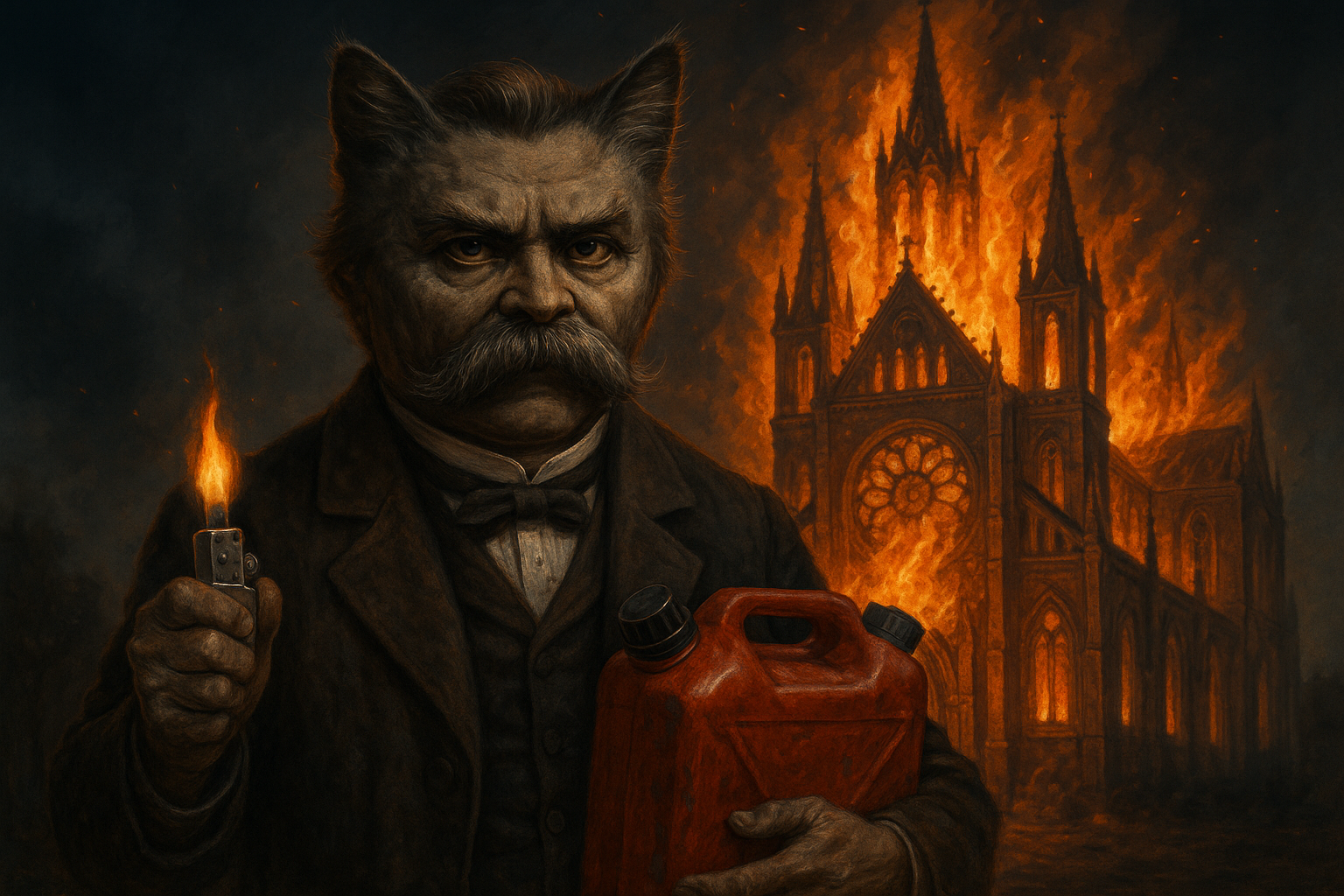
I’ve been meaning to write something like this for a while—a kind of long-form reflection on Christianity, religion as a whole, and what happens when you start to question the beliefs you grew up with. If you’ve followed my podcasting, you know I’ve spent a lot of time thinking about mental health, personal development, and philosophy. But at the core of a lot of my journey is a very personal story about faith, skepticism, and where to find meaning when you let go of the old answers.
So, let’s get into it. Think of this as a meandering walk through my notes, my experiences, and the ideas that have shaped how I see religion today. Grab a coffee, settle in, and let’s talk about Christianity, religion, and what comes after.
Growing Up Christian: The World I Inherited
I grew up in a Christian household, where concepts like eternity and absolute truth were just part of the air I breathed. The idea that there was a purpose to everything, that suffering had meaning, and that there was a loving God orchestrating it all—these were foundational. Like a lot of people, I didn’t question much at first. Why would I? The framework seemed to answer the big questions, and it was comforting.
But life isn’t always so neat. When I lost my siblings, I found myself asking questions that didn’t have easy answers. Who would I see in heaven? Would my brother and sister keep growing, or would they be frozen at the ages they were when they died? These were not just theological puzzles—they were deeply personal, and the answers mattered in a way that made me uneasy when they didn’t quite add up.
The Fear of Questioning
I’ll be honest: for a long time, I was afraid to really interrogate my beliefs. My Bible sat on my desk for months, untouched, because I was scared that if I started poking at my worldview, it would all fall apart. There’s a kind of existential dread that comes with questioning something so foundational. What if it’s all false? What’s left if you take God out of the picture?[1]
Eventually, though, the questions became too loud to ignore. I started reading, listening to debates, and talking to people who’d wrestled with these same issues. I realized that what I was experiencing wasn’t unique—there’s a whole movement of people going through similar “deconstruction” journeys, sometimes called the “Rise of the Nones” (as in, no religious affiliation).
The Problem of Faith and Evidence
One of the big turning points for me was grappling with the difference between faith and evidence. I started to see that faith, at least as it’s commonly used in religious contexts, is what you invoke when you don’t have good evidence for a belief. If you did, you’d just present the evidence. The more I thought about it, the more uncomfortable I became with the idea of believing something so strongly without a solid foundation.
I landed on skepticism as my default approach—not because I wanted to be a contrarian or because I thought it was “cool” to be a skeptic, but because it’s a process that helps you bypass your own biases. It’s a way to make sure that what you believe is actually true, or at least as close to true as you can get. There is no answer for hard solipsism, the only thing I can ever truly be certain of is that I exist—everything else, I have to evaluate based on logic and evidence.
Critiquing Christianity: Theological Puzzles and Moral Dilemmas
As I dove deeper, I started to see some real problems with core theological concepts. Take omnipotence, for example: Could God make a rock so heavy that he can’t lift it? If yes, then he’s not omnipotent. If no, then he’s also not omnipotent. The same kind of paradoxes come up with omniscience—if God knows the future, he can never change his mind, because he would have foreseen whatever would cause him to change it. And when it comes to morality, you run into the issue of needing a pre-existing idea of objective morality before you can even begin to prove God’s existence. You can’t use God to prove morality if you need morality to prove God.
Then there’s the Bible itself. I’ve listened to countless hours of debates between people like Jordan Peterson and Sam Harris, and I’ve read books from both sides. At the end of the day, I can’t get past the fact that the Bible contains some pretty messed up shit—hatred toward homosexuals, women being treated as less than men, rules about slavery and violence. Even if you find metaphorical value in the stories, you can’t just hand-wave away the problematic parts.
Nietzsche, “God is Dead,” and What Comes Next
A lot of my thinking has been influenced by Nietzsche, especially his idea that “God is dead.” What he meant wasn’t that God literally died, but that the old ways of grounding meaning, morality, and truth in a transcendent being have become unbelievable in the modern world. Christianity, in a way, trained people to value truth so much that they eventually started questioning the very foundations of the faith itself. The Enlightenment and the rise of science can be seen as the logical outgrowth of this—Christianity’s insistence on truth-seeking eventually led to its own undoing.
Nietzsche’s take is that, with the “death of God,” we lose the old certainties and have to create our own values. This isn’t just a philosophical problem—it’s a psychological one. The priest used to manage the community’s psyche, but now that role is up for grabs. Nietzsche worried that most people would be lost without the old framework, drifting into nihilism, while only a few “free spirits” would be able to build new values from scratch.
Science, Skepticism, and the Modern World
For me, the rise of science and skepticism has been both liberating and challenging. Science isn’t perfect, but it’s a process that’s always correcting itself. When someone finds a better theory, science adapts. That’s a far cry from ancient holy books, which don’t change unless they’re forced to by outside pressure. In fact, the only reason Christianity and other religions have changed over the years is because science, secularism, and atheism have forced them to. Without that pressure, we’d probably still be stoning people in the streets for breaking ancient taboos.
Skepticism, in this context, isn’t about being a cynic or a nihilist—it’s about having a system to make sure your beliefs are warranted. It’s about using logic and evidence to decide what’s true, rather than just accepting something because it’s comforting or familiar.
Finding Meaning and Morality Without Religion
So what happens when you let go of the old religious answers? How do you find meaning and purpose, and how do you figure out what’s right and wrong?
First, I think it’s important to acknowledge that the “gap” between what is and what should be doesn’t just disappear when you leave religion. If anything, it becomes more obvious. We all have an idea of the world as it is, and a sense of what we think it should be. The question is how you bridge that gap without appealing to a higher power.
For me, it comes down to creating personal values based on my own experiences. I dig into the people, places, and experiences that have been meaningful to me and ask why they mattered. What themes keep coming up? What does that reveal about what I actually value? From there, I try to build a life that’s aligned with those values, rather than just following a script handed down from on high.
Morality, too, becomes something you have to take responsibility for. I’ve found Sam Harris’s arguments about grounding morality in well-being compelling—you don’t need a god to know that less unnecessary suffering is better than more. If we are being honest, one could argue for grounding morality in well-being strictly from a selfish point of view. It’s not perfect, but it’s a start. At the very least, it’s an honest attempt to figure out what makes life better for people, rather than just following ancient rules because they’re old and your parents followed them.
The Upsides and Downsides of Leaving Religion
Let’s be real: there are some real benefits to moving beyond religious thinking. You get freedom from dogma and illusions. You have the space to create your own values and meaning, rather than just inheriting them. There’s a kind of authenticity that comes with aligning your life with what you actually believe, rather than what you’re supposed to believe.
But it’s not all sunshine and rainbows. There’s a loss of community, for one thing. Religion does a great job of giving people a sense of belonging, shared rituals, and a support network. When you leave, you have to find or create that elsewhere. For me, that’s meant building new communities around shared interests, personal growth, and honest conversation. It’s not always easy, but it’s possible.
There’s also the challenge of facing the big questions without easy answers. Why are we here? What does it all mean? I don’t have tidy answers to those questions anymore, but I’m okay with that. Part of being a “free spirit,” as Nietzsche would put it, is learning to live with uncertainty and to find meaning in the process of searching, not just in the answers.
Spirituality, Mindfulness, and Personal Growth
Although I've moved away from supernatural beliefs, I haven't given up on personal development and growth. I find tremendous value in evidence-based practices like meditation (which has been scientifically studied), philosophical inquiry, and exploring fields like neuroscience and psychology. These pursuits aren't about connecting to anything mystical - they're about understanding ourselves through the lens of science and reason, learning how our brains work, and using that knowledge to live more fully and consciously.
Final Thoughts
If you’re on a similar journey—if you’re questioning the beliefs you grew up with, or if you’ve already left religion behind—I hope this resonates. It’s not an easy path, but it’s one that can lead to greater honesty, freedom, and personal growth. You don’t have to have all the answers. Sometimes, just asking the questions is enough.
Thanks for reading. If you want to keep the conversation going, drop a comment or shoot me a message. I’m always up for a good chat about life’s big questions.
← Back to the blog