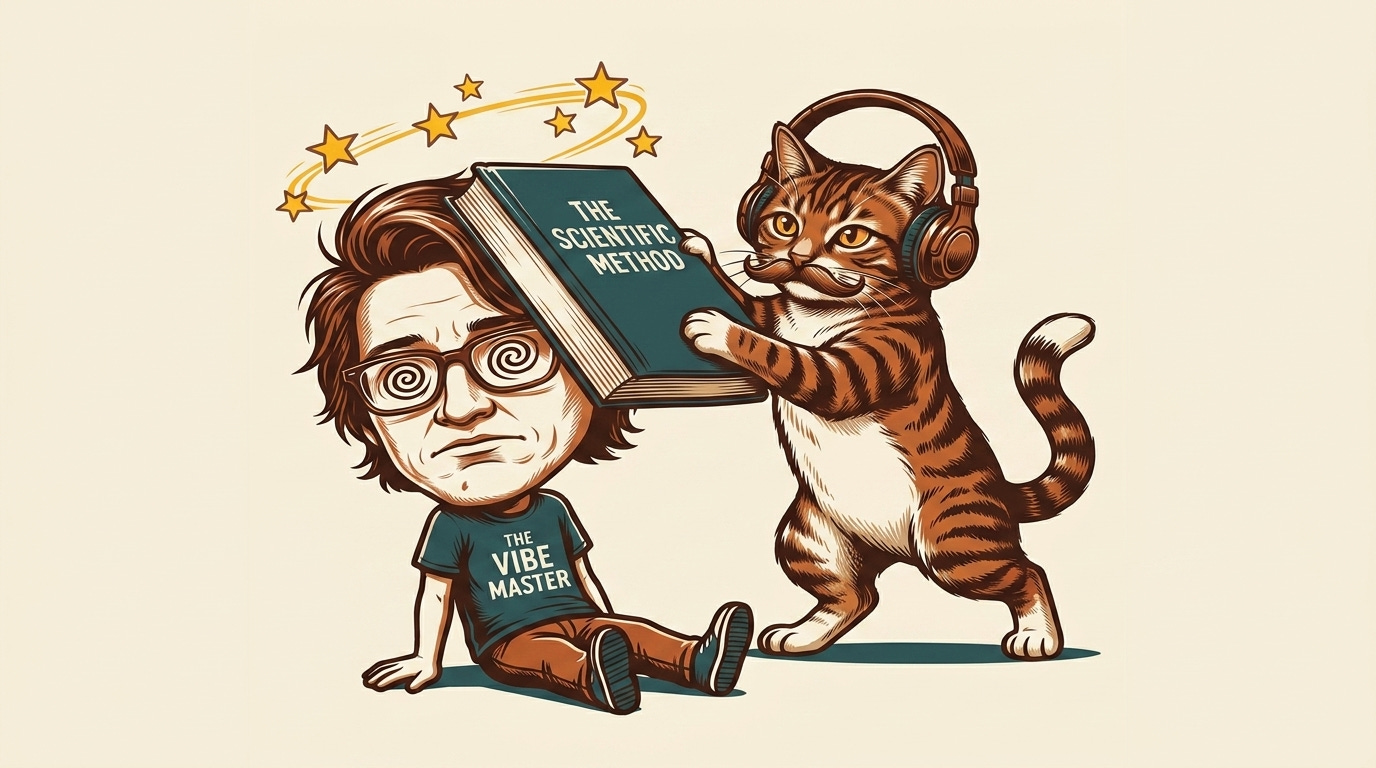
The following is a reflection of a back-and-forth I had with with a New Age “Spiritual But Not Religious” gentleman. I tend to keep track of a lot of these conversations for my own records. It helps me to see where I was wrong, where need to dig deeper, and/or where I am fallacious.
This one was a bit of punching down, but the many examples of crappy thinking were to hard to pass up. It’s a bit on the longer side, but should be a fairly quick read.
It didn’t take long for me to realize how ignorant this gentleman was to the current scientific literature and even how the scientific method generally works. He threw out so many buzz words that if we were playing bingo I would have won within the first few comments.
Bad reasoning and why “science is just belief” is not the intellectual flex people think it is
There is a specific kind of person who discovers spirituality, reads a few books, watches three YouTube videos about quantum mechanics, gets emotionally renovated by a mushroom trip or shadow work, and then walks into public discourse like they personally audited the operating system of reality.
You know the type. They say things like:
“Science/Logic is just a belief”
“Everything is energy”
“Einstein basically proved Buddhism to be true”
“You just have to be open-minded”
“I’m not trying to convince anyone of anything”
And then, immediately after announcing they are “not trying to convince anyone,” they proceed to make eighteen claims about consciousness, God, Jesus, quantum physics, radio waves, gurus, shadow work, death experiences, and the deep metaphysical meaning of a cucumber.
Yes!!
A effin cucumber!
We’ll get there, don’t worry.
This is the written companion to my first “Sarcasm & Substance” episode I will be releasing on my YouTube channel in just few days. It’s ultimately about bad faith interlocuters and shitty reasoning and it pulls from two types of buckets.
Christian call-in debate clips where people make huge claims about God, evidence, morality, and truth to turn around and then immediately collapse when asked basic questions.
And the second, which this article mainly focuses on… A long private conversation thread with a New Age / Eastern spirituality / Jung / “science is belief” type of thinker I’m going to call The Vibe Master.
Obviously that is not their real name. That does not really matter. Their identity is not the point, and it will be blurred in the video.
The point is the pattern. It’s been the same “techniques” used for hundreds of years by Christians, New Age folk, and the like.
They all like to think they are different from one another, but they are not, they are the same and use the same moves to slime their way out of putting their money where their mouth is.
They are structurally cousins.
Different merch table. Same reasoning disease.
The Christian says:
“I know because I feel the Holy Spirit.”
The New Age person says:
“I know because I felt the energy shift.”
The Christian says:
“Science can’t explain miracles.”
The New Age person says:
“Science can’t explain consciousness.”
The Christian says:
“You just need faith.”
The New Age person says:
“You just need to be open.”
Different vocabulary.
Same escape hatch.
And the escape hatch is this:
“I had a powerful experience, therefore my interpretation of that experience is true.”
That is the leap.
That leap is where the bullshit lives.
Evidence Is Not Whatever Made You Feel Certain
Before we get into the circus, we need to define the terms. Because if we do not define evidence, every conversation eventually turns into somebody staring into the middle distance and saying:
“Well, that’s true for me.”
No.
That is not how truth works.
Truth is not a private emotional subscription service.
Evidence is not “something that made me feel certain.”
Evidence is information that actually increases the probability that a claim is true or likely to be true.
And the bigger the claim, the better the evidence needs to be.
If you say:
“I felt peace during meditation.”
Fine. I believe you.
If you say:
“Therefore consciousness is fundamental, the universe is made of light, gurus can project thoughts through radio waves, and science is basically just another religion.”
Now we have left the wellness retreat and entered the parking lot of epistemic malpractice.
There is a difference between:
“This experience changed me.”
and:
“This experience proves something about the structure of reality.”
That distinction is everything.
Your experience can be real as an experience, but your explanation of the experience can still be wrong.
You can really feel peace in church.
You can really feel awe during meditation.
You can really feel like the universe is sending signs.
You can really feel like your dead relative visited you in a dream.
But the feeling does not prove the metaphysical story you attach to it.
That is not me being closed-minded.
That is me refusing to let your nervous system write physics textbooks.
The “Science Is Just Belief” Escape Hatch
One recurring move in the conversation was:
“Science is all based on belief.”
“Nothing is a guaranteed fact.”
“How do you know the sky is blue?”
“How do you know 2+2=4?”
This is the classic hard-solipsism trap. It sounds deep if you are hearing it for the first time. After that, it becomes the philosophical equivalent of a toddler hiding behind a curtain with their shoes sticking out.
Yes, absolute certainty is difficult.
Yes, all knowledge rests on some assumptions.
Yes, we cannot climb outside our own minds and inspect reality from God’s balcony.
Congratulations.
You have discovered Philosophy 101. Now what?
Because the question is not:
“Can we have absolute certainty about everything?”
The question is:
“Can we distinguish better-supported claims from worse-supported claims?”
And the answer is obviously yes.
Science does not need absolute certainty.
Science needs models that make predictions, survive testing, explain observations, and can be corrected when they fail.
That is the point.
Science is not a cathedral of certainty. It is an error-correction machine. And that is exactly why it is not the same as faith-based metaphysics.
If your spiritual claim fails, you can say:
“Well, the universe works in mysterious ways.”
If a bridge fails, engineers do not say:
“The steel was not aligned with abundance.”
They investigate.
They test.
They find the load failure.
They update the model.
Nobody wants a suspension bridge built by “my truth.”
I do not care how spiritually open the architect is. If the math says the bridge collapses, I am not driving across it because someone named Moon River said structural integrity is a Western construct.
Belief, Faith, and the Equivocation Olympics
A lot of these arguments survive by abusing one word:
BELIEF.
People say:
“Well, you believe in science.”
“You believe in logic.”
“You believe 2+2=4.”
“Therefore my spiritual belief is just as valid.”
No.
This is equivocation.
“Belief” can simply mean holding a proposition to be true.
In that broad sense, yes, I believe my car is in the driveway.
I believe water is H₂O.
I believe bacteria exist.
I believe Australia exists, even though I am not staring at it right now.
But that is not the same kind of belief as:
“A guru used mind control to make a man steal a cucumber.”
Again, yes, that was a real example from the conversation material.
We went from mass-energy equivalence to telepathic cucumber espionage.
That is not a worldview.
That is a rejected Adult Swim pilot.
The issue is not whether humans have beliefs.
Everyone has beliefs.
The issue is whether those beliefs are accountable to evidence.
Scientific beliefs are supposed to be revisable. If the evidence changes, the model changes. That is the entire effin point. But a lot of spiritual and religious claims are built like spiritual cockroaches. No matter what evidence shows up, the belief survives.
Prayer works?
God answered.
Prayer fails?
God said no.
Energy healing works?
Vibration aligned.
Energy healing fails?
You were blocked.
Prophecy happens?
Fulfillment.
Prophecy fails?
Wrong timing.
Science agrees?
Science is catching up.
Science disagrees?
Science is too materialistic.
That is not an argument.
That is a rigged casino where the belief never loses.
Logic Is Not a Belief System
One of my favorite moments was when logic itself got accused of being a belief system.
Because of course it did.
At some point, when evidence becomes inconvenient, the next move is:
“Well, logic is just your belief system.”
This is where the conversation puts on a fake mustache and tries to sneak out of the building. Logic is not a belief system in the same way Christianity, Buddhism, Marxism, capitalism, astrology, or “I watched one Jordan Peterson video and now I understand the West” are belief systems.
Logic is a structural framework.
It helps evaluate whether conclusions follow from premises. It does not tell you what religion to believe.
It does not tell you who to vote for.
It does not tell you whether Mercury is in Gatorade.
It tells you whether your argument is structurally coherent.
Basic example:
Premise 1: All mammals are warm-blooded.
Premise 2: Dogs are mammals.
Conclusion: Dogs are warm-blooded.
That is valid.
Now compare that to:
Premise 1: I had a powerful spiritual experience.
Premise 2: Science cannot explain everything.
Conclusion: My preferred metaphysical story is true.
That does not follow and that is not logic.
Yes, logic has axioms.
Yes, humans reason from frameworks.
Yes, there are debates in philosophy about foundations.
But none of that means every claim is equally justified.
If you deny logic, you have to use logic to make the denial.*
It is like saying:
“Language is useless.”
using a sentence.
Thank you for demonstrating the thing you are trying to destroy.
[*This is not to say that there is not some problems with grounding logic, but that’s a different conversation for a different time]
“Do You See Germs?” and Other Arguments From 1847
Another move that came up throughout my conversation with “spiritual but not religious” was:
“In the West we think we have to see something to believe it. Do you see germs? Love? Disease?”
I guess this was suppose to embarrass the skeptic.
It does not.
It embarrasses the argument.
Science has never meant:
“I only believe things I can see with my bare eyes.”
That is not science.
That is a raccoon inspecting a flashlight.
We believe in germs because they are observable with instruments, causally connected to disease, biologically modeled, experimentally tested, genetically sequenced, and controlled through interventions like sanitation, antibiotics, and vaccines.
We do not believe in bacteria because a shaman had a dream about microscopic vibes.
We believe in bacteria because they leave measurable, repeatable fingerprints. Same with disease. You do not need to “see” diabetes floating in the room like a ghost in a lab coat. Scientist measure blood glucose, insulin function, biomarkers, tissue damage, symptoms, outcomes.
The point is not naked-eye visibility.
The point is publicly testable evidence.
Love is also not accepted as a supernatural substance because someone wrote a poem.
Love is a word we use for a cluster of behaviors, emotions, attachments, neurochemical processes, social commitments, and subjective experiences.
Can we reduce all love to a lab result?
No.
But that does not mean “love exists” and “astral radio-wave mind control exists” are in the same evidence category.
That is the scam.
People take real limits in human knowledge and use those limits to smuggle in whatever metaphysical petting zoo they prefer.
Quantum Is Not Magic Wearing a Lab Coat
Now we have to talk about quantum mechanics. Because New Age spirituality uses the word “quantum” the way toddlers use glitter. Just throw it everywhere and hope nobody asks what it means.
Quantum healing.
Quantum manifestation.
Quantum consciousness.
Quantum abundance.
Quantum womb astrology.
Quantum trauma release.
Quantum relationship coaching.
At some point, this is not spirituality. It is a Mad Libs generator with incense.
One of the claims that came up was basically:
“Buddhism says everything is an illusion made of light, and Einstein proved everything is made of light.”
No.
No, Einstein did not prove that your guru can send thought-rays through the spiritual FM band.
Einstein’s equation, E = mc², describes mass-energy equivalence.
It does not mean matter is fake.
It does not mean consciousness creates reality.
It does not mean the universe is a vision board with better lighting.
Energy in physics is a measurable quantity.
It is not a vibe.
It is not spirit.
It is not the feeling you get after drinking mushroom tea and saying “alignment” too many times.
Physicists use energy in a strict mathematical sense. Spiritual influencers use energy to mean mood, aura, personality, trauma, God, intuition, and sometimes just “I do not like your tone.”
That is not deep. That is semantic laundering. They borrow the authority of science while refusing the discipline that makes science reliable. It is like stealing a doctor’s coat and then diagnosing everyone with blocked moon chakras.
If you want to use scientific language, you inherit scientific responsibility. You do not get to say “quantum” and then sprint away from math like it owes you child support.
The Cucumber Guru and Anecdotes as Evidence
Now we have to address one of the greatest moments in the history of human reasoning. A story was offered as evidence that spiritual masters can do things we might consider magic.
The story involved a guru, a student, a house, and cucumbers under a bed.
Apparently, a man enters the house, ignores valuables, goes directly to the cucumbers, takes one, and leaves.
The suggested explanation?
The guru used mind control to teach the student a lesson.
Ladies and gentlemen, we have found it:
telepathic cucumber espionage.
Forget the CIA.
Forget MKUltra.
Forget neuroscience.
The true frontier of consciousness research is a spiritually weaponized salad ingredient.
Now, could the story be meaningful as folklore?
Sure.
Could it be a moral teaching about pride, attachment, carelessness, or humility?
Absolutely.
Could it be exaggerated, misremembered, embellished, symbolic, or invented?
Of course.
But if you want to claim it is evidence of actual mind control, now we are in a different category.
Now you need something better than:
“I read it in a book.”
Because that standard proves everything.
The Quran says Muhammad split the moon.
The Book of Mormon has golden plates.
Ancient myths have gods turning into animals.
People claim alien abductions.
Children believe in Santa.
Somebody somewhere probably has a story about a haunted toaster.
If “a story exists” is your standard, then congratulations: your worldview now has to admit every weird claim humanity has ever produced.
That is not open-mindedness, it is epistemic food poisoning.
Yogananda, Decomposition, and Miracle Marketing
Another claim that came up was that Paramahansa Yogananda’s body did not decompose for months. This is often used as evidence that he had some kind of spiritual mastery over the physical body.
Now, this is exactly where epistemic standards matter.
Because the question is not:
“Does this sound incredible?”
The question is:
“What actually happened, and what is the simplest explanation?”
Bodies decompose at different rates depending on conditions.
Temperature, humidity, oxygen, embalming, storage, and mortuary practices all matter.
If a body has been professionally embalmed and stored in controlled conditions, delayed visible decomposition is not automatically a miracle.
It is mortuary science.
But miracle marketing loves omission.
It takes a partial fact:
“The body looked unusually preserved.”
Then leaves out boring details like:
“Was the body embalmed?”
“What were the storage conditions?”
“What did the full mortuary report say?”
“Were there early signs of desiccation?”
“Who benefits from presenting this as miraculous?”
That last question is not cynicism it is basic source criticism.
Religious and spiritual movements have incentives.
Followers want confirmation.
Institutions want authority.
Biographies want mythology.
Nobody starts a spiritual empire with:
“Our founder decomposed within normal parameters.”
That does not move books.
That does not sell retreats.
That does not get embroidered on a pillow.
Spiritual Experiences Can Be Real Without Your Explanation Being True
This is where sloppy skeptics screw up. Not everything in spiritual practice is fake or useless.
Ritual can change people.
Meditation can change people.
Drumming, chanting, fasting, breathwork, prayer, psychedelics, grief rituals, confession, community; these can all produce real psychological effects.
The experience can be profound, the transformation can be real, and the healing can be meaningful.
But again, we have to separate two things:
Phenomenology — what the experience feels like from the inside.
Ontology — what exists in the external world.
If someone says:
“During a ritual, I felt the presence of a spirit.”
I do not need to deny that they felt a presence.
The question is:
“What caused that experience?”
Was it an external spirit?
Or was it expectation, rhythm, sensory deprivation, social priming, stress regulation, altered attention, neurobiology, and/or cultural interpretation?
That is not dismissive. That is the actual question.
The human brain is capable of generating powerful experiences, altered states, intense emotion, pattern detection, meaning-making, identity-level transformation.
That supports:
“Humans can enter powerful altered states.”
It does not automatically support:
“External spirits exist.”
Those are different claims. And if you slide between them, you are not doing spirituality. You are doing metaphysical three-card monte.
Near-Death Experiences and Moving the Goalposts
Near-death experiences and shared death experiences came up too. This was another moment where I through a bunch of studies at him that he never bothered to look at and responds with such confidence.
The move was:
“There won’t be testing, because someone has to die.”
That is false.
There have been attempts to test out-of-body claims.
Some studies have used hidden visual targets in hospital settings, the kind of thing a disembodied consciousness should theoretically be able to report if it is literally floating above the body.
The results have not established reliable hidden-target perception.
Now, do people have near-death experiences?
Yes.
Do those experiences feel vivid, meaningful, and sometimes life-changing?
Yes.
Do they prove an afterlife?
No.
Again, this is the phenomenology/ontology problem.
A dying or stressed brain can produce powerful experiences. Hypoxia, anesthesia, trauma, memory reconstruction, cultural expectation, and altered neural activity all matter.
And when the evidence does not support the clean ghost hypothesis, the claim often moves.
First:
“People leave their bodies.”
Then:
“Okay, maybe not in a testable way.”
Then:
“But shared death experiences happen.”
Then:
“But it cannot be tested.”
Then:
“Science versus spirit is the problem.”
No.
The problem is not science being mean to ghosts.
The problem is that your claim keeps changing costumes every time we ask it for ID.
Jesus as A Projection Screen
Now let’s move to Christianity.
Another recurring pattern is using Jesus as a projection screen.
People say:
“Jesus stood against injustice.”
“Jesus was anti-establishment.”
“Jesus was about love.”
“Jesus was against empty rules.”
And there is truth in that.
Jesus does challenge hypocrisy. He does heal on the Sabbath. He does identify with the poor and marginalized. Jesus does criticize the religious elites.
But if you rarely read the Bible and then confidently tell people what Jesus was really about, we have a problem.
Because Jesus is not just a modern progressive life coach with sandals.
The texts are more complicated.
Jesus also says he did not come to abolish the Law. He tells people to follow those who sit on Moses’ seat.
He limits his mission to Israel in certain passages.
He speaks in apocalyptic judgment language.
He demands extreme loyalty.
He talks about punishment and eternal torment.
He is a first-century Jewish apocalyptic figure, not a 2026 Instagram therapist.
So before using Jesus as a mascot for your preferred politics, spirituality, or anti-institutional vibe, you need to answer:
Which Jesus?
Historical Jesus?
Gospel Jesus?
Church doctrine Jesus?
Mystical archetype Jesus?
Personal moral symbol Jesus?
Because those are not the same thing.
And if your Jesus conveniently agrees with everything you already believe, there is a decent chance you are not following Jesus and you are looking into a pond and calling your reflection Lord.
“Translation Is Basically Art” and the Dunning-Kruger Fog Machine
After calling The Vibe Master out on how little he knows about The Ancient Near east, another move he went to was:
“There are no translations for the language.”
“It is extremely difficult to interpret.”
“Every interpretation is different.”
“It is more like art than science.”
This is what happens when someone learns that a field is complicated and then immediately concludes that nobody knows anything.
That is not humility.
That is the Dunning-Kruger fog machine.
Yes, translation is difficult.
Yes, ancient languages require expertise.
Yes, manuscripts have variants.
Yes, historical context matters.
Yes, interpretation is contested.
But “difficult” does not mean “anything goes.”
Classical Hebrew, Greek, Aramaic; these are not magical vapor languages floating in a cave of vibes.
They have grammar, syntax, morphology, lexicons, manuscripts, comparative data, and scholarly methods.
You cannot say:
“Nobody can really translate this.”
when you have not done the work.
That is not skepticism, that is ignorance wearing a graduation cap.
And notice the pattern.
When science is inconvenient:
“Science is belief.”
When logic is inconvenient:
“Logic is a belief system.”
When biblical scholarship is inconvenient:
“Translation is basically subjective art.”
Every time a discipline applies pressure, the discipline itself gets demoted.
That is not truth-seeking.
That is belief protection.
“I’m Not Trying to Convince Anyone”
One of the funniest recurring moves that we came back to over and over again is:
“I’m not trying to convince anyone.”
Right after making claims about:
science being belief
Einstein proving everything is made of light
gurus doing mind control
radio being based on spiritual projection
Yogananda’s body not decomposing
Jesus being this or that
logic being a belief system
death experiences pointing beyond science
That is persuasion behavior.
You do not get to throw claims into the room, tell people to look them up, accuse them of arrogance when they ask for evidence, and then say:
“I’m not trying to convince anyone.”
That is like throwing a brick through a window with a note attached that says:
“Not trying to break glass.”
If you are making claims about reality, you are entering the evidence arena.
You do not have to be aggressive.
You do not have to be formal.
You do not have to write a dissertation.
But if you want your claim to be treated as “truth”, you need standards. And “look it up” is not a standard.
“Google says” is not a standard.
“A book said” is not a standard.
“I had an awakening” is not a standard.
“It changed my life” is not a standard.
Those might be starting points, but they are certainly not conclusions.
Bad Faith Is Not Just Being Wrong
Now I must make an important distinction.
Bad faith does not mean “you are wrong.” People can be wrong honestly. I am wrong about things. You are wrong about things. Everyone is wrong about things.
Bad faith is when someone is not actually tracking truth.
Bad faith looks like:
changing definitions midstream
moving the goalposts
demanding evidence while refusing to provide it
treating criticism as arrogance
pretending not to understand simple distinctions
retreating into mystery when the claim gets pinned down
using science language without scientific discipline
using theology language without textual discipline
using philosophy language without logical discipline
lowering standards for your side and raising them for everyone else
Bad faith is not always conscious either. Sometimes people are so trained to protect a belief that they do not notice the defense mechanism firing.
But the effect is the same:
Truth gets replaced by identity protection.
And that is the whole point of this episode.
I do not care if you are Christian or a if you are Buddhist.
I do not care if you meditate, pray, do shadow work, read Carl Jung, or collect crystals in a tiny velvet bag like Pokémon.
The question is:
Are your claims accountable to reality?
If yes, great.
Bring evidence.
Define your terms.
Make predictions.
Accept correction.
Steelman critics.
Separate experience from explanation.
If no, then stop pretending this is about truth.
Just say:
“This belief comforts me.”
That would be more honest than playing games and acting like you know what you are talking about.
A Better Standard
Here is the checklist.
When someone makes a claim, ask:
What exactly are you claiming?
Is it metaphorical, psychological, moral, historical, scientific, theological, or philosophical?
What evidence supports it?
Is the evidence public or private?
Is it independently verifiable?
Could the claim be false?
What would change your mind?
Are you using the same standard against your own belief that you use against others?
Are there simpler explanations?
Are you confusing emotional certainty with truth?
That checklist will kill a shocking amount of nonsense.
Not because it is complicated.
Because most bad beliefs survive by avoiding basic inspection.
If someone says:
“Science cannot explain everything.”
Ask:
“Which thing specifically? And how does your explanation follow?”
If someone says:
“Everything is energy.”
Ask:
“Energy in what technical sense?”
If someone says:
“Logic is a belief system.”
Ask:
“Are you using logic to argue that?”
If someone says:
“There is no evidence anything exists.”
Ask:
“Then why are you using a phone designed by people who trusted evidence enough to build semiconductors?”
If someone says:
“You just have to be open-minded.”
Ask:
“Open to evidence, or open to lowering my standards until your claim gets through?”
That last one matters.
Because “open-minded” often means:
“Please turn your brain off so my claim can sneak past security.”
No.
The brain has a bouncer for a reason.
Sarcasm With Receipts
FYI: I do enjoy using sarcasm.
A lot.
Because some arguments deserve mockery.
If you say “quantum manifestation” with no understanding of quantum mechanics, I am making fun of you.
If you say logic is a belief system because a Google snippet said philosophy is a type of belief system, I am making fun of you.
If you tell me a guru used mind control to convince someone to steal a cucumber, I am absolutely making fun of you.
That is not optional.
That is civic hygiene.
But the sarcasm cannot outrun the receipts.
That is my biggest rule.
If I get something wrong, correct me.
If I misrepresent an argument, call it out.
If there is a stronger version, send it.
Because I do not want to become the thing I am criticizing.
If my standard is:
“Christians and New Age people need better evidence,”
then I need better evidence too.
If my standard is:
“Do not argue in bad faith,”
then I need to steelman before I swing.
If my standard is:
“Logic matters,”
then I do not get to win by vibes either.
So yes, we are going to joke.
But underneath the jokes is a serious commitment:
Truth does not care what comforts you.
And if your belief cannot survive basic questions, maybe the problem is not the questions.
I deconstructed from Christianity because I wanted to know if the people telling me I was going to see my dead siblings again one day were correct…
I am not here to be comforted.
The Takeaway
If your belief is true, better standards will not hurt it.
If Christianity is true, evidence should not be the enemy.
If New Age spirituality is true, testing should not be a threat.
If your worldview collapses the second someone asks:
“How do you know that?”
then maybe you do not have a worldview. Maybe you have a defense mechanism with merch.
This is not just about religion.
Bad reasoning makes people easier to manipulate.
By pastors.
By gurus.
By politicians.
By influencers.
By conspiracy theorists.
By anyone who knows how to weaponize certainty.
The most dangerous people are often not the ones who know they are lying. It is the people who are emotionally committed to never noticing they might be wrong.
So bring the evidence.
Bring the logic.
Bring the definitions.
Bring the citations.
Bring the willingness to change your mind.
And if you cannot do that, at least bring enough self-awareness to stop acting like everyone else is the problem.
Confidence is not evidence.
Vibes are not a methodology.
And quantum is not magic wearing a lab coat.
I am officially relaunching the Room 9 YouTube channel and I will be going through this entire conversation there. If you’re up for it, hop on over there and Subscribe.
← Back to the blog